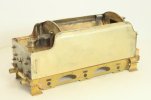
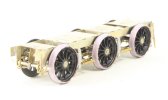
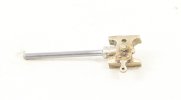
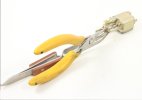
7mm MOK 8F - 8425

Rob Pulham

Western Thunderer
You too Chris, it was good to have a few minutes to chat. I don't think we got much beyond introductions last year. I had a good weekend too.

 

Rob Pulham

Western Thunderer
This morning I was getting ready to fit the sides when I double checked the bends against the sides of the inner cage and realised that I had my bends a little too low on the side so the tender side would sit flush without having to force it into place. Past experience has taught me that while you can force items into place and then solder them the odds that the solder under tension will give at some point in the future so I elected to do something about it before soldering the sides on.

Bending kit etches has become a bit topical, so I thought I would go into a bit more detail about how this came about and what I did to get around it.

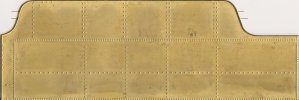
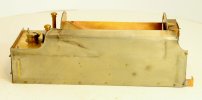
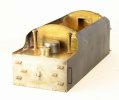
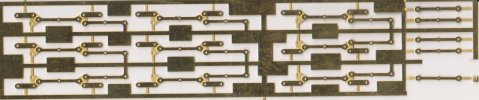
As supplied the Just Like The Real Thing Stanier Tender kit that I am using had riveted sides which came with some little etched tabs to guide you where to make the top fold.

You can see the small tabs with the red lines against them in the image below.

54790025193_b0656c4c6b_b.jpg

By laying one JLRT side over the replacement MOK welded side I transferred the bend lines over. Unfortunately these lines create a guide rather than a specific place to bend and I had got it wrong. Now being half etched and nickel getting the bend to move was going to prove a little tricky. However I reasoned, that worst case scenario I could use the flat JLRT sides as a template to cut out some replacements from 10 thou nickel sheet if I made a mess of things.

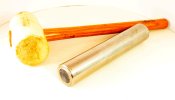
The first thing that I did was to ease the fold line that was too low. I did this by carefully beating it with a rubber mallet, using a thick steel tube filled with lead as a makeshift anvil.

54789765881_b7206b084c_h.jpg

Note that I was using a curved surface rather than a flat one. The idea being to ease the bend back into a shallow curve rather than trying to flatten it completely and risk leaving a crease.

Next I measured the tender side to see where the start of the bend should actually be rather than working to a guestimate between the two previously marked lines.

54790046968_d59b113229_h.jpg

On one side it was 4.5mm at each end and the second side it was 4.5mm at one end and 5mm at the other I transferred these marks to the outside of the MOK tender sides so that I could drop them in my folding bars and still see the line as I positioned it ready for rebending.

You can just make out the middle line in the image below.

54789031562_e0a207b6f3_b.jpg

Then finally I bent it in the right place.

54790250095_8cd4ab3dce_h.jpg
 

Rob Pulham

Western Thunderer
Well they say that pride goes before a fall.

I was feeling quite pleased with myself having managed to move the fold in the thin material without it creasing so I went ahead and soldered the first side on. Not having learned my lesson from a similar experience when I built the Class 5A a few years ago I tinned all the bit of the inner cage and the sides and lower section of the curves of the bulkheads.

54794616203_7add8d2994_h.jpg

Then using the RSU I spot tacked the side in place but struggled to get it to stay in place and ended up being a bit heavy handed which resulted in a number of creases.

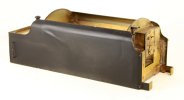
Now they do actually look a bit prototypical in that I have seen lots of photos of tender with seams/panels and creases and dents visible at certain angles but it's not what we tend to model. My other question mark besides can I live with it is that during my modelling period this tender would be relatively new and I am not sure that the premise of a wartime Friday afternoon at Swindon is enough of an excuse to leave it be.

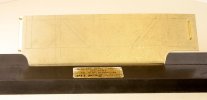
Not the easiest things in the world to take photos of so in the end I squirted a bit of primer at it to get a better view of what it might look like after paint.

54793512152_5a23e232d1_h.jpg

54793512317_01204417f5_h.jpg

54794363821_51ee736c3e_h.jpg

54794616508_4434cbc01c_h.jpg

54794693035_e231183084_h.jpg
 

Rob Pulham

Western Thunderer
Rob, I have a horrible feeling that you are not going to find that crease acceptable..........

Might be able to supply new sides if you need them.

Cheers
Dave
You are right Dave, I wouldn't leave it like that if I were building for someone else and it's already bugging me. Ironically the other side went on without a hitch.

Thanks for the offer of replacement sides it's much appreciated but I have cut one out already and I am just about to cut the other (not sure why I but I have cut the good side replacement out first... Go figure) I am doing both as I want them to look the same.
 

Rob Pulham

Western Thunderer
I always knew in my gut that I wasn't going to be able to live with them so a couple of days after my last post I ripped the battered sides off and cut some more from 10 thou nickel sheet.

54802118952_6425bbb77a_h.jpg

Ironically the side that went on okay came off in pretty good shape too.

This was the basic sides cut out ready for detailing before fitting.

54796774813_41db27aa10_b.jpg

I managed to salvage the handrails and handrail knobs from the damaged sides and it was a simple enough job to fit them to the new sides. Initially I was planning on adding the side then fitting the beading but in the end I also opted to fit them first while the sides were manoeuvrable.

I also remembered that to make the MOK rear sheet match the new scratch built sides, I would need to remove the half etched upper beading and replace it. Being half etched it was soon removed with a few strokes of a file. I fitted a length of 0.7mm half round beading along to the rear and left each side a bit long to blend in when the sides were fitted.

I didn't take any photos of the sides before I fitted them but this is the creased side after being replaced.

54803214859_377b93857c_h.jpg

The other side had to be replaced to match.

54802966156_f98c3d3117_h.jpg

The rear beading and other details such as the fire iron tunnel and tank vents were also fitted.

54803224718_9088db13b5_h.jpg

I have also made start on adding the other details to the front.

While much muttering had ensued, in hindsight I am glad it happened in a way because I feel the new sides look much better than the half etched MOK ones did on this tender.
 

Rob Pulham

Western Thunderer
While chatting to Richard G on the phone last night I said that I wasn't going to post any more on the tender because it's really a repeat of what's gone before on the build but then today, I had a hiccup in proceeding so I thought it worth sharing how I got out of it.

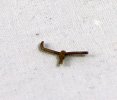
The kit provides two of these Windlass castings for the water scoop and brake standard.

54847404690_cca5232c11.jpg

As I was cutting the second one off the sprue it pinged off into space and despite searching the workbench top, I couldn’t find it. Having no idea which way it went, I don’t know where to start looking.
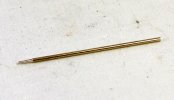
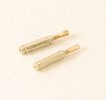
So, I decided that it wouldn’t be too big a job to make a couple of replacements to match. Staring with some 1.5mm brass rod I cross drilled it and turned down the end.

54847084051_0b84f4e5a6_b.jpg

Parting off such a thin piece on the lathe was bound to be a disaster so I opted to cut it off with a piercing saw while it was still held in the collet and… you guessed it, that too pinged off into the swarf and was lost for ever.
Having set everything up it was a few minutes job to prepare some more. This time I played it safe and held the main stock in one pin vice and the part to be cut off in another.

54847331649_c2a6dad244_h.jpg

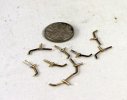
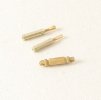
Having established the workflow I decided not only to make the two that I needed but to do a few more for the spares box too. The ones I need for the tender need quite a short stem but I also did some with longer stems just in case I need them for upright brake standards in the future.

54846225437_e533cafc8a_b.jpg
 
Last edited:

adrian

Flying Squad
Having set everything up it was a few minutes job to prepare some more. This time I played it safe and held the main stock in one pin vice and the part to be cut off in another.
Instead of the second pin chuck you could have threaded a length of wire through the hole you had previously drilled to prevent it from escaping when cutting.
 

Rob Pulham

Western Thunderer
I
Instead of the second pin chuck you could have threaded a length of wire through the hole you had previously drilled to prevent it from escaping when cutting.
I didn't think of that, yep that would do it too.
I wonder how soon it will be before the missing casting turns up.
 

Rob Pulham

Western Thunderer
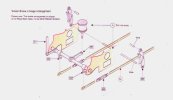
Having sorted the water scoop thoughts turned to the brakes as being the last major items to fit. This is where life got a little interesting. As I mentioned previously the kit is “borrowed” from my Just Like the Real Thing, Rebuilt Scot kit. According to the JLRT instructions, the brakes for the Royal Scot tenders differed from the usual Stanier tenders being much simplified.

Below is a snip from the instructions illustrating the simplified version.

54877374556_970a88af2a_c.jpg

Fortunately, JLRT did provide an etch for the linkages, albeit they didn’t include any cross beams. Presumably this was intended for use with another kit which included a Stanier tender but I can’t think of one in the JLRT range.

54876517352_d78549ab5e_b.jpg

This left making up some cross beams. I started with some 2mm brass rod and having cut three lengths I turned a spigot on each end to fit through the holes in the brake hanger castings.

54871279183_8b302d2e7c_h.jpg

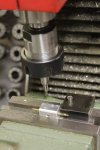
Next, I created a small jig which is essentially a rectangular block to hold the cross beam rods to allow me to machine parallel flats on each end.

54871294054_0c310aef42_h.jpg

54877397261_21725a3960_h.jpg

Finally, for the session, I machined a replacement brake cylinder.

54875214818_3894e10d63_c.jpg
 

Rob Pulham

Western Thunderer
Today was quite satisfying in so much as I got the brake beams assembled and I also got the new brake cylinder and the front cross shaft fitted which in theory leaves the brakes, the rear coupling and the small etches and pins which fit on the outside of the outer frames adjacent to one end of the springs where they represent the ends of the brake hangers.

The Proxxon mini pillar drill earned its keep drilling all the holes for the link pins on the cross beams.

54882095738_5dd91e9e97_h.jpg

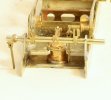
Next, I fitted the brake cylinder and the front cross shaft. The shaft and the castings which attach to the brake pull rods are still loose until I work out the correct orientations of them.

54881007572_63aa64b8de_h.jpg

Lastly a close up of the new brake cylinder.

54882167560_1433e164d3_h.jpg

Making and fitting all these extra parts has renewed my enthusiasm for the build which was waning a little.
 

Rob Pulham

Western Thunderer
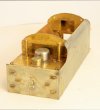
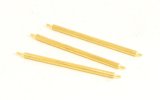
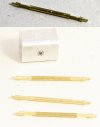
Yesterday morning saw the brakes fitted. I did need to make a couple of brake adjusters for two reasons. One being that the suppling casting looked a bit over scale although I can see why, as it’s designed to be fitted in between two upright pieces of etch. The second and ultimately more fundamental is that I only have one of said castings and I need two. I added a piece of rod that fits between a clevis casting and rather than mess about trying to mill flats on something so thin, I elected to squash them in pliers and tidy that up a little with a file.

54886839147_2875d7f77b_c.jpg

This shot shows the difference between the casting that I have and the replacements.

54887958964_379d69afaf_b.jpg

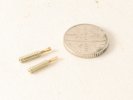
Plus, the obligatory shot with a 5P piece for scale.

54887716681_ccfd56ed9f_h.jpg

Those made, it didn’t take long to solder all the brakes up and make it look the part.

54887868296_d92a18c907_h.jpg

54888112834_4cc70cbac2_h.jpg

54888091418_e441a546e9_h.jpg

Lastly, I made up the JLRT LMS style coupling. Although I managed to get it all together as it should, (without soldering anything up solid), I even made the “tommy bar” moveable. I did have to turn a new pin to go through the top links and the hooks as the casting was just a touch too short

54888210926_c3a1252083_h.jpg
 

Rob Pulham

Western Thunderer
Very neat, but I can't workout how that coupling works!

Dave

That's because dummy here has assembled it wrong... DOH!!!

As you may guess if you have experience of JLRT's basic instructions, there nothing included for assembling the couplings and I have managed to get the tommy bar above the upper trunnion instead of below it.

No wonder I had to file some of the top to get it to clear the bottom of the hook.
 

Rob Pulham

Western Thunderer
I wonder if a few people have got these wrong. - I have just noticed that there is a spare sprue of all the parts except the hook included, for both the front and rear couplings...
 

Rob Pulham

Western Thunderer
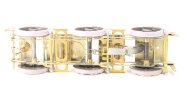
Now that I have largely scratched my gear cutting itch, I returned to the 8F in the last couple of days. Starting with revisiting the chassis.

First, I resoldered a couple of bits of the cylinder wrappers where they had sprung over time due to being under tension. Then, I noted that in the dim and distant (2013) when I first built the cylinders and fitted the slide bars and cross heads, I had fitted piston rods from 2mm brass bar.

9056127541_c683b3be0b_h.jpg

I cannot recall whether they came separately or whether the cast piston rod was so out of shape that I cut them off and drilled them out to accept a piece of rod. In any event not knowing any better I had used brass rather than nickel of anything that remotely looked steel like. As soon as I picked them up, I decided that they had to go. So initially I planned to use some nickel rod.

Unfortunately, my 2mm nickel rod is in fact 1.86mm so was very sloppy fit in all the holes. I also had 2.25mm and I did attempt to turn it down but ended up with multiple fine steps which wouldn’t fit either. However, what I do have is some 2mm ground silver steel so I cut a couple of pieces and used that. I used Bakers Fluid as flux and soldered them in. Although a reasonable fit in the holes in the cross heads I found that getting the piston rod ‘square’ in all planes was a bit if a trial. Made slightly more awkward by the fact that the drop links are a separate item soldered on so I had to be careful that I didn’t have them fall off as I soldered the piston rods in.

54939497381_99671cd0e8_h.jpg

After initially soldering the piston rods in and finding that they didn’t runs smoothly due to being slightly out in one plane or another I hit upon the ide of fitting the cross heads into the slide bars then I gripped the drop link in a pair of pliers so that it didn’t move and then I slipped a pair of self-locking tweezers over the slide bars where the cross head was (with the piston rod fed into the gland at the other end). I then used the Microflame to heat the crosshead/piston rod joint, until the solder started to melt.

Then, as the solder melted again there was a satisfying click, the self-locking tweezers pulled the cross head into line with the slide bars and with the piston rod being held in line in the gland, it made everything line up in all planes. When cooled, the cross head/piston rod runs very smoothly indeed. A quick rinse and repeat for the other side had both crossheads running nicely. I think that when I assemble the rest of the motion, I may need to shorten the piston rods a little but I will wait until later in the build to determine that for certain.

54939497736_ef9d1a143f_h.jpg
 
Top