M&BR Coal Wagon

Jon Nazareth

Western Thunderer
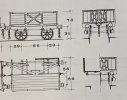
IMG_5451.jpeg

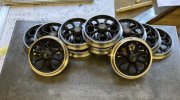
I’ve cut some styrene for the underframe of this wagon but not machined it to length as yet. It’s interesting to see that the width is marked up as 8 feet which is wider than I’ve modelled before. I’ve ordered extra styrene for the body but that won’t arrive until late next week. I’ve also ordered some leaf springs et al to go with it. I know that they are not shown here but I shall be using a set of the nine open spoke wheels on her as mentioned in my other post.

Jon
 

Jon Nazareth

Western Thunderer
Brian
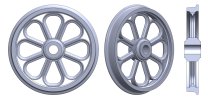
This picture accompanied the above drawing and it measures as a 3’ wheel. It looks as if the spoke has a T cross-section too.

Jon

IMG_5454.jpeg
 

Brian McKenzie

Western Thunderer
Might the spokes have been formed from a sandwich of two flat bars? I suspect the rivet-like fitting into the rim is a locating peg - to keep all together when fire welding.

But is that a rim inside a separate tyre, or merely a chamfer on the inside of the tyre?

-Brian McK.
 

simond

Western Thunderer
I remain very dubious about the radial rivets - the necessary hole in the tyre seems like the most perfectly awful stress raiser, even if it were countersunk on the rolling face and the rivet closed up to fill the hole.

is it possible that the wheel had a rim rivetted to the spokes, and the tyre was then fitted hot and shrunk on?
 

Jon Nazareth

Western Thunderer
Simon
I’m thinking similar thoughts that there was a rim riveted to the spokes. How it was fitted to the rim ‍♂️.

Jon
 

Mike W

Western Thunderer
If there was a rim rivetted to the spokes, then the tyre could have been held by a Gibson ring or similar. But I'm not sure when that was invented?

Mike
 

Brian McKenzie

Western Thunderer
I don't imagine that the 'fasteners' connecting spokes to the inside of the wheel were rivets penetrating the tyre, but perhaps were locating pegs that got forge hammered when the the assembled wheel was melded together when very hot. This would be important at the hub of the wheel.

We may have been fooled into thinking that the spokes might have been T-shaped. The spokes, as illustrated could represent thick bar with its inner face being half-rounded l ), or heavily chamfered.

-Brian McK.
 

Overseer

Western Thunderer
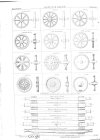
These scans from The Practical Railway Engineer by G. Drysdale Dempsey published in 1855 might help. A similar wagon described as a wagon for heavy loads, this one had doors at both ends. The wheels look like cast iron. The wheel drawing shows some interesting variations, figure 2 looks similar to the wheel being discussed. And yes, fixing bolts were inserted all the way through the tyres on some wheels, see figure 1.
dempsey wagon.jpg
dempsey wheels.jpg

Many of the drawings in the 4mm Railway Drawings book that Jon's drawing is from are direct tracings from D.K. Clark Railway Machinery. Railway Machinery is available to download from https://babel.hathitrust.org/cgi/pt?id=njp.32101048875593&seq=7. Dempsey is probably also available online. This is from Clark's Railway Machinery -
DKClark wheels.jpg
 

Jon Nazareth

Western Thunderer
Overseer
That’s a much better and crisper wagon drawing than the one that I have. Is there a list that corresponds with the letters possibly giving the sizes of the timbers?
With the wheel design, it’s looks as if yer will have to pay yer money and take yer choice.

Jon
 
Last edited:

Overseer

Western Thunderer
Overseer
That’s a much better and crisper wagon drawing than the one that I have. Is there a list that corresponds with the letters possibly giving the sizes of the timbers?
With the wheel design, it’s looks as if yer will have to pay yer money and take yer choice.

Jon
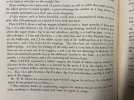
Unfortunately the text is not very informative for this wagon. Plate LXVII -
dempsey plateLXVII.jpg
 

Jon Nazareth

Western Thunderer
Thanks for taking the trouble to post the page. Your drawing did explain one thing and that was that the corner posts sail down over the ends of the buffer beams.

Jon
 

Mike W

Western Thunderer
The original Clark drawing doesn't show the body in plan whereas the later one does. I wonder whether the later draughtsman had additional information (like from a diagram book) or assumed that the doors were at one end - as we discussed earlier.

Mike
 

Jon Nazareth

Western Thunderer
Brian
Thanks for that. It never ceases to amaze me what can be drawn these days on a computer when I’m still using a draughting board with parallel motion.

Jon
 

Jon Nazareth

Western Thunderer
Mike
In the side view of the drawing that I posted there is that fixing in the end of the buffer beam but no reason as to why it is there. That is, until you look at Overseer’s drawing showing the corner posts sailing down over the end of the beam. With a similar thought, maybe whoever drew up my version, couldn’t be bothered to include doors at the other end as he missed out the line on the face of the beam. We’ll never know.

Jon
 
Last edited:
Top