7mm Llanbister Rd.

Geoff

Western Thunderer
Not much has been happening over the past few weeks, I've just been plodding along trying new ideas out on the layout and pondering over others.
P1210834-EDIT.jpg

All the wiring has now been tidied up and buried under the scenery, it's easily accessible should the need arise, so no worries on that score.

P1210833-EDIT.png

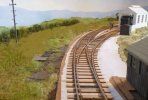
I recently came across a few photos showing Kington Shed, not that I'm modelling it accurately, but they provided some much needed information regarding the size of the coal stage. So the rough mockup has been cut down, I also discovered that a grounded van body was sited along the side of the shed. It looks rather attractive in the photo, so that's another detail that I'll probably add. The corrugated iron hut has now been bedded in, and rough grass is slowly being added around it and the catch point, and I intend to model some unkempt brambles between the hut and the coal stage. I'm still unsure as to what will develop on the far side of the track, perhaps a meandering section of the River Lugg will appear amongst other things?​

P1210847-EDIT.jpg

Another thing that I've been working on is how to model the ground frame that will control the point leading into the shed, its FPL and the catch point. I'm reliably informed that unlike the LNWR, the GWR provided some form of shelter for their ground frames. The hut that you see here is based on the one that once stood at New Radnor. It's built from styrene sheet and though I'm happy with it so far, I'm having second thoughts and am thinking of modelling the frame as per the example at Kington, where it was sheltered underneath the road overbridge.
20260628_133629.jpg

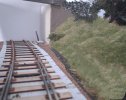
This is what I have in mind, but the bridge when it gets built will need slewing over to give a bit more space between it and the frame. Talking of the bridge, I've removed the wingwalls to see how it would look. But having researched the geology of the Upper Lugg Valley and taking the rainfall into account, it might be best to model them.

20260628_133647.jpg

It's still a case of work in progress when it comes to the frame, which is being constructed from styrene. The levers have been salvaged from the MSE frame that once graced Bleadffa Road. I've just received a supply of point rodding stools, cranks and components for an FPL which were printed to order by Modelu. So the plan is to complete the frame, plan the rodding runs and lay in the timbers for the stools and cranks before ballasting. But I'm getting ahead of myself because the dreaded job of adding fishplates will have to be tackled first. :(

Geoff.
 

Geoff

Western Thunderer
I always love your gentle curves, does that sound right? You know what I mean.

Oh Alan, you are awful, but I like you. :D

Very interesting and great modelling as ever, Geoff. I think the New Radnor hut looks rather good and would add to the scene, in my view.

Thanks Tim,

Both ground frame options appeal to me, but I do wonder if a hut would have been provided for a simple two lever frame that controlled nothing more than the entry to a loco shed?

Geoff.
 

cmax

Western Thunderer
Morning Geoff,

As ever your modelling is simply stunning, as Alan points out, the gentle curves on Llanbister Road & Bleadffa Road are / were perfect. The new ground frame hut, looks excellent, but I do rather like the lever frame under the bridge.

Gary


Northroader

Western Thunderer
I would be inclined to stick with the ground frame hut. The guy working it would need to communicate with the signal boxes who owned the block, so block repeater instruments would be needed, plus a telephone, all needing shelter from the elements. The hut is a standard GWR design, very characteristic, and would fit in well with the rest of the scene, being quite compact.
 

Geoff

Western Thunderer
Morning Geoff,

As ever your modelling is simply stunning, as Alan points out, the gentle curves on Llanbister Road & Bleadffa Road are / were perfect. The new ground frame hut, looks excellent, but I do rather like the lever frame under the bridge.

Gary


Hi Gary,

Thank you for your kind comments.
Having the ground frame beneath the bridge is a very attractive feature and true to prototype, its different and at the moment it's a clear favourite.

Geoff.

I would be inclined to stick with the ground frame hut. The guy working it would need to communicate with the signal boxes who owned the block, so block repeater instruments would be needed, plus a telephone, all needing shelter from the elements. The hut is a standard GWR design, very characteristic, and would fit in well with the rest of the scene, being quite compact.

Hi, thanks for taking an interest and for taking the time to post a comment.

I'm told by a fellow modeller who has an interest in signalling that the ground frame would most likely have been operated in the following manner by the fireman. In simple terms any locos wanting to go on shed would have stopped short of the entry turnout, the fireman would have then pressed a plunger on the ground frame to request the signalman to release it. He would then release the FPL and set the road, the same sequence would be carried out when leaving the shed. So when you consider the number of movements on and off the shed every day, a hut wouldn't really have been needed, especially as the frame would have been sheltered from the elements under the bridge.

Geoff.
 

Nick C

Western Thunderer
I'm told by a fellow modeller who has an interest in signalling that the ground frame would most likely have been operated in the following manner by the fireman. In simple terms any locos wanting to go on shed would have stopped short of the entry turnout, the fireman would have then pressed a plunger on the ground frame to request the signalman to release it. He would then release the FPL and set the road, the same sequence would be carried out when leaving the shed. So when you consider the number of movements on and off the shed every day, a hut wouldn't really have been needed, especially as the frame would have been sheltered from the elements under the bridge.
I'd agree, having gone back a few pages to check your map - there would be a release lever in the signal box that'd unlock the frame, and at the same time lock the home signal to protect the movement.

If it were more remote from a station (e.g. a private siding somewhere in section), it'd be more likely to have an Annett's key on the train staff to unlock the frame.
 

PhilH

Western Thunderer
I don't know whether these may help or not:


Manod.jpg

The ground frame controlling entry to the goods yard sidings at Manod on the Bala-Blaenau Ffestiniog Branch with a slightly subsided shelter. The rodding supports on this line were small concrete blocks, but I've no idea whether this was general on the GWR. I assume the device with the longer supports on the catch point rodding is to reverse the direction of throw (?)


Pickhil Halt.jpg

The alternative - under a bridge. The siding to the creamery at Pickhill Halt on the Wrexham-Ellesmere Line. Plenty of room here of course as the overbridges were built to allow double track. (excuse the quality - cropped from a larger negative)
 

James Spooner

Western Thunderer
I would suggest that somewhere there needs to be at least a cupboard to hold the electric token machine. If the loco enters the siding with the shed and the point is reset to the through route, there will then be a need to return the token to an intermediate token machine, to enable another train to enter the section.

Nigel
 

Geoff

Western Thunderer
I'd agree, having gone back a few pages to check your map - there would be a release lever in the signal box that'd unlock the frame, and at the same time lock the home signal to protect the movement.

If it were more remote from a station (e.g. a private siding somewhere in section), it'd be more likely to have an Annett's key on the train staff to unlock the frame.

Thanks Nick, That's the explanation that I was originally given.
Geoff how is the shed from the junction?

Many thanks for the photos Phil, which are full of interest. That's the third version of what the GWR called a 'standard hut' that I've come across. To the best of my knowledge, the GWR used both concrete and timber bases for the point rodding. I've been laying timbers this afternoon and have also soldered up a compensator.
I would suggest that somewhere there needs to be at least a cupboard to hold the electric token machine. If the loco enters the siding with the shed and the point is reset to the through route, there will then be a need to return the token to an intermediate token machine, to enable another train to enter the section.

Nigel

A token machine wouldn't be needed Nigel, as the ground frame is close to the signal box. If it was further away, then an Annett's key would have been used.

Geoff how is the shed from the junction?

Are the points within the protection of fixed signals controlled by that signal box?

I hope this photo of Kington by L E Copeland will answer your questions gents.........

506090438_1378731163382883_3853051645600963711_n.jpg

You can see the roof of the shed in the distance and just make out the ground frame and the point rodding beneath the bridge. The signal box was behind the photographer on the platform. The arrangement at Llanbister Road would be very similar, but the track would curve to the right into the station.

Geoff.
 
Last edited:

PaxtonP4

Western Thunderer
That's what I was wondering - if they're within the station limits then a release lever in the box is all that's needed.
That all depends on the status of your station. If the station is not a block post then the sidings would normally be worked by the section token (which the train or engine will have) unlocking the ground frame. There is no need for there to be any communication with the signal box because the train/engine is in section with a token.

If it is a block post then it will obviously be under the control of the signal box.

If the block post can be switched-out then the arrangement is usually, when the box has been "switched out", that the "long section" token will unlock a portion of the box frame to enable the sidings to be operated. There would also be a dedicated block instrument to enable the "Long section" token to be returned should the train/engine be "locked in" the siding/yard.
 
Last edited:

Geoff

Western Thunderer
Certainly Kington, in Geoff's photo, was a block post while the New Radnor line was open and the box did not have a switch, as far as I am aware.

Morning Tim.

Well, I've certainly opened a can of worms with my latest update. :)

I'm not sure if you have this book in your collection, the final chapter, titled "Single Line Working & Signalling", might be of interest.

P1210807-EDIT.jpg

This extract from the book might be of interest, I best point out that the New Radnor extension was worked as one engine in steam.

Before the man at New Radnor went off duty each night, he had to give Kington a release to control slide one, or the engine could not leave Kington shed the next morning until the New Radnor man was back on duty. The man at Kington had to remember not to put slide one to normal to fully normal working during this period, otherwise he lost the release.

Thanks to everyone for showing an interest and sharing such interesting and photos.

Geoff.
 
Top