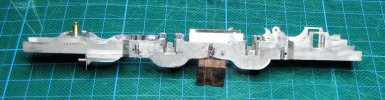
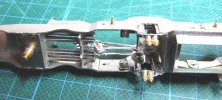
Latest project: ex-LNER C13, No. 67421

Dave Holt

Western Thunderer
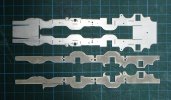
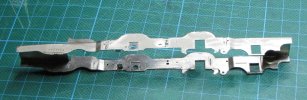
Some rather lovely custom etches arrived recently, produced by Rumney Models from design sketches provided by me. These will provide parts for the chassis and some body detailing to supplement a set of profile milled parts from Jeremy Suter and some dummy valvegear parts from Dave Bradwell from his J39 kit.
Hopefully, all the parts will gel together to produce a fair representation of C13, No. 67421, as running in the mid to late 1950s - superheated, mechanical lubricator, patch plates on the tanks and bunker and vacuum push-pull fitted.
The loco will haul two push-pull converted ex-GCR coaches I purchased some time ago from Larry Goddard and converted to P4.
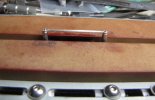
Jusin's lovely etches:
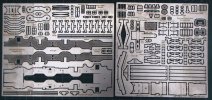
C13_001.JPGC13_002.JPG
Dave.
 

Dave Holt

Western Thunderer
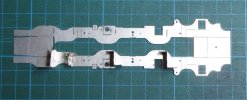
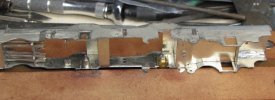
I have started work by cutting out and cleaning up the main frame and overlays (and some of the spacers - not shown). These need to be fixed together before joggling the frame plates, as per the prototype.
Here are the main, fold-up inner frames and the two outer overlays. One has been modified at the upper front to better suite the body interface. The other shows the snap line created using an Olfa cutter (idea stolen from PAD:rolleyes:).
C13_003.JPG
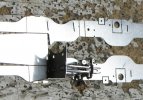
Here one overlay has been (temporarily) attached to the inner frames using two 14 BA set screws and nuts. I later separated them to clear out the various slots in the inner frames where the tabs on the spacers locate.
C13_004.JPG
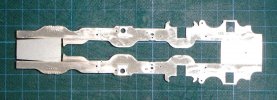
C13_005.JPG
C13_004.JPGC13_005.JPG
Dave.
 

Dave Holt

Western Thunderer
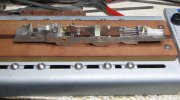
The main frame stretchers have been prepared, including the motion plate with its brackets either side, and loosely placed in position in the slots in the inner frames. In practice, these will be sprung into place in the folded up and joggled frame unit. I might try to keep the cylinder rear cover and motion plate, joined by the slidebars, as a separate loose insert, at least till the dummy inside valve gear has been assembled.
C13_006.JPGC13_007.JPG
Dave.
 

Dog Star

Western Thunderer
Looking at your etch frame plates I wish to ask a question... do you have access to a GA or frame plan of this class?

regards, Graham
 

mickoo

Western Thunderer
Graham.
The GCR GA and Pipe & Rod drawings are available from the NRM.
Dave.
That's good to know, I've looked and have never found them or the LNER A5.

I'd really like to know the drawing numbers if you have them please, it's a long term project for me to.
 

Dog Star

Western Thunderer
The GCR GA and Pipe & Rod drawings are available from the NRM.
I shall be pleased to be given the relevant catalogue references....

Peter and I were at the NRM in March of this year and we looked at the GCR contractor rolls... and in many cases, especially the 4-4-2T, the GA and frame plan drawings have been removed from the relevant roll. So, no, the required 4-4-2T drawings are not at the NRM.
 

Dave Holt

Western Thunderer
The slide bars have been folded up and fixed into the slots in the cylinder rear cover. They proved to be rather delicate and tricky job to file off the etch cusp and fold and fit without destroying them.
Anyway, after a bit of tweaking and fettling, here they are temporarily fitted into the motion bracket and loosely slotted into the frames.
C13_009.JPGC13_010.JPGC13_008.JPG
Wont be able to put off laminating and joggling the frames for much longer.
Dave.
 

Dave Holt

Western Thunderer
OK. The drawings I obtained from the NRM were Cat No: 10350, LNER (GC) Pipe & Rod arrangement for 4-4-2 tank (9k) GCR (2 cards); 10713, LNER (GC) GA of 4-4-2 tank engine 9k (Vulcan) (2 cards) and 10716, LNER (GC) GA of 4-4-2 tank engine C13 GCR (2 cards). All are ex-Oxford Publishing. They were bought (£15 each) as digital images back in 2015.
The image quality isn't brilliant but does allow most dimensions to be read and details made out. Unfortunately, the end views/cross sections do not include the valvegear, motion plate or driving wheel springs.
Hope that helps.
Dave.
 

Dave Holt

Western Thunderer
Perhaps I should have said that, despite the differing catalogue descriptions, all the NRM drawings show the locos in original GCR form, with saturated boiler, GC boiler fittings and low bunker. There may have been other drawings in the catalogue that I didn't identify.
The only drawing I've found of the locos modified with superheated boilers, long smokebox, LNER chimney, dome and pop safety valves, VCR push-pull gear and mechanical lubricator (my era) is a 4 mm scale version by C.A. Reddy, published in Railway Modeller in November 1968.
Dave.
 

Dave Holt

Western Thunderer
Further progress with the C13 chassis. Crazily, I did the trickiest bits between 1 and 2 am, this morning - after a meal out and a visit to the pub. Despite that, it seems to have gone quite well.
First, the frame overlays were attached to the fold-up inner. I used 179 degree solder, stating in the middle and slowly working outwards, soldering short lengths at top and bottom edges, to try and prevent any wrinkling of the thin overlays. The layers were held together using the two 14 BA screws, hair grips (as previously shown) and parallel jaw pliers held close to the stretch being soldered.
The result was this:
C13_011.JPG
The laminated frames were joggled at the half-etched bend lines, initially using a couple of multi-layer jigs from the etch under the outer ends and the edge of my set square pressing down behind the inner fold line, generally as shown here, although this photo was taken after final folding of the chassis, as I neglected to take any photos at the time.
C13_012.JPG
Unfortunately, perhaps due to the stiffness of the laminated frames and short moment arm for the bending operation, the resultant depth of joggle was insufficient and had to be adjusted by incremental further bending by hand, holding the parts of the frames either side of the joggle in parallel jaw pliers. The required amount of joggle was checked using the shank of a 1.1 mm drill bit against a straight edge, generally as shown here.
C13_016.JPG
All the joggling was done with the frames in the flat, so to speak. Once the joggling was deemed satisfactory, the frame assembly was folded, by hand and in small increments at the four folds, until the frame plates were at right angles to the integral spacers. After adjustments to ensure squareness and freedom from twist, the folds were reinforced with solder, the front ends of the frames bent inwards and soldered.
Here are the folded up frames.
C13_013.JPGC13_014.JPGC13_015.JPG
Trial loose fitting of some of the frame stays has revealed some design errors which will require some slight modifications to my original ideas. Hopefully nothing too drastic.
Dave.
 

Dave Holt

Western Thunderer
The footplate required some small modifications to enable it to fit to my chassis design. This involved extending the central hole at the front to accommodate the top of the frames sticking through and to allow for the joggled frame plates. Unfortunately, I misjudged the rear mounting hole in the chassis etch and it's roughly half a hole out. Not too hard to overcome when the time comes.
The rear spacers have been soldered in and the centre "Z" spacer loosely clipped into its slot. All still seems good.
C13_017.JPG
Dave.
 

Dave Holt

Western Thunderer
I thought I aught to get on with some of the functional bits, so assembled the High Level horn guides and axle boxes. A slight modification was necessary to allow the guides to fit higher in the frame cut-outs than normal, to allow the bottom edge to be level with the bottom of the frames.
My Avonside Works chassis jig had already been set up using the coupling rods, as seen here.
C13_018.JPG
With the etched hole over one jig post, the first horn guide/axle box was positioned,
C13_019.JPG
then fixed to the frame plate. Note the centre pop marks on the underside of the axle box to identify its location. There's a similar marking on the horn guide, not visible in the photo).
C13_020.JPG
Then the other side was attached.
C13_021.JPG
The next operation will be to saw out the front axle fillers and use the jug to locate the front horn guides from the rears already fitted.
Dave.
 

Dave Holt

Western Thunderer
The front axle hornguides have been fitted using the chassis jig and locating off the rear axleboxes, already fitted. Further progress includes fitting the brake hanger pivots and the main compensating beams. These latter proved to be quite a struggle to get into position due to my poor planning and design but, with a bit of judicious bending and lots of wiggle, they are finally in place, as seen here.
C13_022.JPGC13_023.JPG
Te final part added today was the ash pan, the rear end of which locates the fore end of the rear keepers. The front keepers locate in a slot at the bottom of the front "Z" frame spacer.
C13_024.JPGC13_025.JPG
Dave.
 

Dave Holt

Western Thunderer
Ploughing on, the axle box keeps have been folded up and temporarily fixed in place with over-long 14 BA screws. The front ones were a bit of an exercise in nickel silver origami and very delicate until reinforced with solder at the folds. I have no idea about the origins of the cast brass coil springs. They were on some sprues with some nice leaf springs, which I must have acquired from somewhere.
The rear, leaf springs are not quite right, so I haven't laminated the layers and am just using them till a corrected version is produced.
Sorry about the photo quality, but they show the basic arrangements.
C13_026.JPGC13_027.JPG
I have discovered a fundamental error in my original sketches for the compensating beam. The bottom edge of the bearing surface onto the tops of the axleboxes is 0.473 mm too low relative to the pivot axis. It doesn't seem practical to take the beams out, now, so careful (and, no doubt, laborious) filing through the horn gaps would appear to be the only solution. Something I'm definitely not look forward to doing. Damn.
Dave.
 

mickoo

Western Thunderer
Take a bit off the top of the bearing, there may be enough meat on them to take all your need. The other option, assuming the beam pivot is soldered both sides, is to cut the pivot rod in the middle of the frames and pull each side out one at a time.
 

Dave Holt

Western Thunderer
Thanks for the axlebox suggestion, Mick. I had thought of that last night but the wall thickness above the bore is only 0.735 mm, less the 0.473 mm to be removed would leave 0.262 mm at the thinnest part. Is that sufficient I wonder? It would be a lot easier than trying to file the beams in situ.
What do people think?
Dave.
 

mickoo

Western Thunderer
Probably too thin, personally I’d take the beams out.

Are there two beams one each side or a central one? If two beams can they slide of the pivot rod?

In which case cut a slot in the rod in the middle and slide the beams to the middle and drop them out. Once trimmed stick then back and gently offset the cut ends to slide a bit of tube over the gap, then bend back and slide tube to join the two.

Trying to file the beams probably won’t work as the bearings are wider than the slot, plus the end of the beam that needs filing is probably also wider than the slot, which means you’ll not be able to fill all of it off neatly.
 

Dave Holt

Western Thunderer
I've parked the compensating beam issue as being too difficult and moved on to something, hopefully, more straight forward - the dummy inside valve gear.
As previously mentioned, this is based around Dave Bradwell's J39 chassis with some parts replaced by etchings to my design to better represent the prototype. So far, I've done the eccentrics and inner crank webs, leaving the con rods still to do. I found it necessary to slightly shorten the eccentric rods, by cutting and splicing, to suit the spacing between the crank axle and the motion plate, which must be less on the C13 than the J39. The con rods will also need shortening.
Here the assembled valve gear is temporarily loose fitted into the frames.
C13_028.JPGC13_029.JPGC13_030.JPG
That will be it till next week as I'm off to Scaleforum in High Wycombe tomorrow. I'll have the chassis with me if anyone is interested.
Dave.
 
Top