
You are using an out of date browser. It may not display this or other websites correctly.
You should upgrade or use an alternative browser.
You should upgrade or use an alternative browser.
Julia,
If you have cut your own worms it might be that they are too 'correct'. I believe that they are overcut to provide a bit more in the way play exists to allow tooth rotation. Of course this is not how gears should in theory be produced but this is another example of how in real life enginering parts are 'adjusted' to produce the result that's required.
Simon,
It's not possible to have the worm turn with the bogie due to the basic Farish bogie design. If that is required a different bogie design is need where the worm gear is place forward of the rotation point of the bogie which is where the pivot of the U/J of the carden shaft needs placing.
Bob
If you have cut your own worms it might be that they are too 'correct'. I believe that they are overcut to provide a bit more in the way play exists to allow tooth rotation. Of course this is not how gears should in theory be produced but this is another example of how in real life enginering parts are 'adjusted' to produce the result that's required.
Simon,
It's not possible to have the worm turn with the bogie due to the basic Farish bogie design. If that is required a different bogie design is need where the worm gear is place forward of the rotation point of the bogie which is where the pivot of the U/J of the carden shaft needs placing.
Bob

-missy-
Western Thunderer
Julia,
given that you have cardans between the motor and the worms, could you not arrange that the worms swivel with the bogies?
Simon
Thanks for the comment Simon. Adding the worms to the top of the bogies is something that I have certinaly considered. I did drift away from that idea a bit though as I wanted to try and keep the rework as 'simple' as possible. Technically, I could just rework the whole chassis and start from scratch but this would mean another long and drawn out project. Something I dont really have the time for.
I do agree that there is a possibility to redesign the bogies to add the worms if I need to.
Julia,
If you have cut your own worms it might be that they are too 'correct'. I believe that they are overcut to provide a bit more in the way play exists to allow tooth rotation. Of course this is not how gears should in theory be produced but this is another example of how in real life enginering parts are 'adjusted' to produce the result that's required.
Bob
Thanks Bob.
These are similar thoughts to what I have been having, although I am using the Farish worms and not my own. Add to that, the possibility that the meshing distances between the worm and the worm gear are not the same as the original too. It is now starting to feel like I will have to dial in the sketchyness of the engineering to suit what I currently am using. The worm 'top' gear I have made was to replicate the farish one (as I only have a single original), so I need to look at it in a bit more detail.
Julia


simond
Western Thunderer
Some years back (about sixty-some) my elder cousin gave me a Treble-0-Lectric train set hand-me-down.
The drive was simple and not as awful as you might think. it was a BB / BoBo diesel loco, the centrally mounted motor had a long armature shaft and the wheels comprised brass turnings in plastic muffs. The drive from armature to axle was a small rubber band with a half-twist. You did have to make sure to get all four half twists the same way…
At this distance it’s hard to be sure but say the muffs were maybe 4mm diameter and the armature maybe 1. Slow running was not perhaps its strong point! Two maroon coaches and a happy youngster.
I have a feeling there was a US outline steam loco with the same drive in the tender. I saw them in magazine adverts but never in the flesh.
its probably not an alternative…
The drive was simple and not as awful as you might think. it was a BB / BoBo diesel loco, the centrally mounted motor had a long armature shaft and the wheels comprised brass turnings in plastic muffs. The drive from armature to axle was a small rubber band with a half-twist. You did have to make sure to get all four half twists the same way…
At this distance it’s hard to be sure but say the muffs were maybe 4mm diameter and the armature maybe 1. Slow running was not perhaps its strong point! Two maroon coaches and a happy youngster.
I have a feeling there was a US outline steam loco with the same drive in the tender. I saw them in magazine adverts but never in the flesh.
its probably not an alternative…
Last edited:

-missy-
Western Thunderer
Hello.
OK, this might be a bit of a curved ball but hey, its my workbench thread!
A while ago I came across this post on YouTube...
Its a guy who has set himself a huge challenge of making a Archer automaton. This particular video detailed ho he overcome the problem of control wire routing within the automaton. The solution he came up with was to manufacture some miniature bowden cables. This inspired me as I have a few ongoing projects where something similar would be very useful.
So, roll on a few weeks later and I came up with this machine...
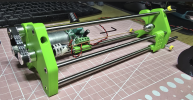
This is my thinking behind it. The guy in the video uses a rigid mandrel in a lathe with some telescoping brass tubing to support both the mandrel and the wire he is using to wind onto the mandrel. I thought to myself that I could take his idea in principle and miniaturise is even further to make really small bowden cables. This would mean to make them in the lathe would be complicated as I would need to power both ends of the mandrel at the same speed to stop any twisting.
Thats where the machine above came from. Its been literally thrown together from some tubing, a few chucks and toothed belts from Ali Express and some 3D printed parts. The idea is the mandrel is clamped between 2 (wobbly) jacobs chucks, the support bracket on the right can slide up and down the tubes so the mandrel can be tensioned, the motor then powers both chucks via toothed belts at either end and a driveshaft between the two ends.
First experiments look promising..
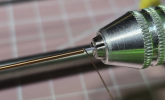
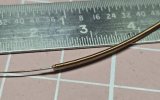
The above is a 0.3mm Phosphor Bronze wire inside a PTFE tube wrapped in 0.2mm copper wire (its all I have right now). It has an overall diameter of just over 1mm.
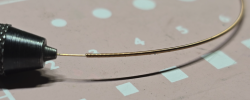
It looks like I can go even smaller. The above is a 0.3mm wire inside a 0.2mm copper spring. Overall diameter is 0.75mm. Both seem to work really smoothly. It hasn't been as straightforward as it looks though, it did take a bit of 'trial and error' to get a feel for what I need to do to achieve the above.
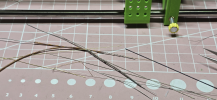
In conclusion, I think that I now have a way to produce my own mini wire in tube bowden cables. There is a huge amount of room for improvement with the machine and technique but it seems to do exactly what I wanted it to as it is. Sure, if I was mass producing something, I could automate more of it but I am not so I don't need to. It was something I threw together to do a specific job.
The plan is to dial in the mandrel size as the diameter and smoothness of the mandrel seems important, plus I have some soft Brass wire winging its way over from China so I can swap out the copper.
Julia
OK, this might be a bit of a curved ball but hey, its my workbench thread!
A while ago I came across this post on YouTube...
So, roll on a few weeks later and I came up with this machine...
This is my thinking behind it. The guy in the video uses a rigid mandrel in a lathe with some telescoping brass tubing to support both the mandrel and the wire he is using to wind onto the mandrel. I thought to myself that I could take his idea in principle and miniaturise is even further to make really small bowden cables. This would mean to make them in the lathe would be complicated as I would need to power both ends of the mandrel at the same speed to stop any twisting.
Thats where the machine above came from. Its been literally thrown together from some tubing, a few chucks and toothed belts from Ali Express and some 3D printed parts. The idea is the mandrel is clamped between 2 (wobbly) jacobs chucks, the support bracket on the right can slide up and down the tubes so the mandrel can be tensioned, the motor then powers both chucks via toothed belts at either end and a driveshaft between the two ends.
First experiments look promising..
The above is a 0.3mm Phosphor Bronze wire inside a PTFE tube wrapped in 0.2mm copper wire (its all I have right now). It has an overall diameter of just over 1mm.
It looks like I can go even smaller. The above is a 0.3mm wire inside a 0.2mm copper spring. Overall diameter is 0.75mm. Both seem to work really smoothly. It hasn't been as straightforward as it looks though, it did take a bit of 'trial and error' to get a feel for what I need to do to achieve the above.
In conclusion, I think that I now have a way to produce my own mini wire in tube bowden cables. There is a huge amount of room for improvement with the machine and technique but it seems to do exactly what I wanted it to as it is. Sure, if I was mass producing something, I could automate more of it but I am not so I don't need to. It was something I threw together to do a specific job.
The plan is to dial in the mandrel size as the diameter and smoothness of the mandrel seems important, plus I have some soft Brass wire winging its way over from China so I can swap out the copper.
Julia
Hi Julia
With regard to the Farish gears and bogies I've been playing around with some parts from the spares box as part of a drive for a very small loco I'm considering making. As I thought but wanted to re-check first they are 84DP. This is of course near enough 0.3Mod which is what I believe the gears on the 2mm drop-in wheelsets are. But it might be that they don't mesh quite as well with the Farish worms as they do the spur gears. The tooth width also needs to be narrow to allow the worm to rotate. Those I have that mate with the worms are around 1mm wide although the core boss is more. Hope this is of use.
Bob
With regard to the Farish gears and bogies I've been playing around with some parts from the spares box as part of a drive for a very small loco I'm considering making. As I thought but wanted to re-check first they are 84DP. This is of course near enough 0.3Mod which is what I believe the gears on the 2mm drop-in wheelsets are. But it might be that they don't mesh quite as well with the Farish worms as they do the spur gears. The tooth width also needs to be narrow to allow the worm to rotate. Those I have that mate with the worms are around 1mm wide although the core boss is more. Hope this is of use.
Bob
-missy-
Western Thunderer
Thank you Bob.
Thats really interesting. I did not consider that the gearing might be imperial instead of metric. It would be weird if that's what they have done for sure. I will check that too when I get round to it. Maybe I need to make a set of replacement worm gears too then.
Julia.
Thats really interesting. I did not consider that the gearing might be imperial instead of metric. It would be weird if that's what they have done for sure. I will check that too when I get round to it. Maybe I need to make a set of replacement worm gears too then.
Julia.
Julia,
A lot of stuff made in China/Japan and elsewhere still uses imperial as does of course the USA. I would assume the gear size originated with Graham Farish here in the UK and remains for continuity. The USA of course still uses imperial so might sit well with all the models produced for that market, the firms are used to the standard.
Bob
A lot of stuff made in China/Japan and elsewhere still uses imperial as does of course the USA. I would assume the gear size originated with Graham Farish here in the UK and remains for continuity. The USA of course still uses imperial so might sit well with all the models produced for that market, the firms are used to the standard.
Bob
-missy-
Western Thunderer
Hello.
Ok, I have now had time to check out Bobs theory.
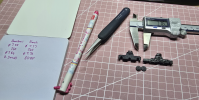
This is what I have found.
Both my homebrew and the Farish gears are 24 teeth. My homebrew gear is 7.84mm in diameter, the Farish is 7.76mm in diameter.
Doing a quick check using this online calculator Gear Size Calculator, it comes up with these results...
My homebrew gear

The Farish gear.

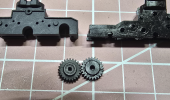
(Farish gear on the right)
So, I now need to work out what to do next. I feel I might be pointing towards remaking the worms or maybe remaking the gears to the same diameter as the Farish ones.
Thank you Bob
Julia.
Ok, I have now had time to check out Bobs theory.
This is what I have found.
Both my homebrew and the Farish gears are 24 teeth. My homebrew gear is 7.84mm in diameter, the Farish is 7.76mm in diameter.
Doing a quick check using this online calculator Gear Size Calculator, it comes up with these results...
My homebrew gear
The Farish gear.
(Farish gear on the right)
So, I now need to work out what to do next. I feel I might be pointing towards remaking the worms or maybe remaking the gears to the same diameter as the Farish ones.
Thank you Bob
Julia.
-missy-
Western Thunderer
easier to make the gears???
If I had a DP80 gear hob, yes. Sadly I don't.
Julia.
Glad you've found the root cause. In this scale and with these sizes it's all really nip & tuck between too tight and too loose. Looking at the photo of the gears side by side you can see that perhaps the biggest difference is the tooth form, or rather the gap is slightly more. I'm sure the mould was made so they represent slightly overcut examples so there is more room for the worms teeth to rotate within that space. This was a basic design Poole Farish came up with but they used large diameter worms with a thus lower helix angle to allow this to work. Bachmann have moved onto much smaller diameter worms and I feel certain these are also 'modified' with regard to the actual tooth form to produce as much tooth depth for constant tooth mesh as feasible with the higher helix angle.
I long ago gave up with trying to come up with home brew alternatives for my bogie diesels and just use the complete Bachmann/Farish ones now on the basis they have been down this road before me. It's interesting to see that most firms making bogie diesels in the smaller scales have now adopted this basic design.
I certainly think just remaking the gear wheel slightly smaller might well be all that's needed to get over the line.
Bob
I long ago gave up with trying to come up with home brew alternatives for my bogie diesels and just use the complete Bachmann/Farish ones now on the basis they have been down this road before me. It's interesting to see that most firms making bogie diesels in the smaller scales have now adopted this basic design.
I certainly think just remaking the gear wheel slightly smaller might well be all that's needed to get over the line.
Bob


-missy-
Western Thunderer
Thank you DebsSo impressed with the distinguished quality of work and inventiveness on display here Julia.
Debs.
-missy-
Western Thunderer
Hello.
So, here it today's update. There has been some success but also some failures to speak about.
18000

During the week I managed to make another set up top worm gears for the engine. This time I made them as closely to the originals that I could manage. The outside diameter was machined to match the originals plus I also increased the gear tooth depth a little.
I assembled one bogie today to test how they work. What I found out wasn't really what I wanted to happen.
This time, there seemed to be a sticky spot while running. This made the whole thing run unevenly. The weird thing is when I checked the gears on their own, they all seemed to run fine and concentrically. Wen the whole bogie was assembled and running I also noticed there was quite a bit of play on the connection between the bogie and chassis, to the extent the bogie was struggling to stay clipped into the associated housing on the chassis.
Rather annoyingly too, the problems with the mechanism stalling when I twisted the bogie was still there. On top of that, the bogie was binding when I pressed down on it to push it together with the main chassis too.
The top gear was made 1.5mm wide to match the original as I mentioned. I then decided to machine this gear to 1mm wide to see if that made any difference. It did not.
So, I have to rethink things...
1. There is a problem with the connection between the bogie and the chassis. This needs to be reworked somehow as there is far too much play. There is not only some sort of problem vertically, but also too much play moving the bogie left to right (along the length of the chassis), plus the problem with the bogie engaging with the clip on the chassis.
2. I need to revisit the meshing distances of the gears to try and work out what they are tight and binding. They are 0.3 MOD so should be free running.
3. There is still the outstanding issue with the mesh between the worm and the worm "top" gear to address too. The idea of mounting the worm onto the bogie is sounding more appealing by the minute at the moment, although this would mean a serious modification to things.
So, its all a bit of a nightmare right now with this project. Not really what I needed.
Bowden Calbles.
This 'side' project seems to be going a little better.

During the week I got a delivery of a couple of things for this project. Firstly, some 0.35mm diameter piano wire for a suitable mandrel, then secondly some 0.2mm diameter soft brass wire for winding. I was itching to try this out on my machine and they both worked really well with a couple of lengths of spring wound without any hiccups.
Today, I managed to progress these a bit further.
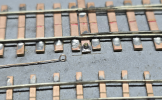
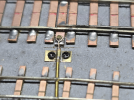
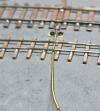
This is my test track that I have been putting together for a while. It needed a way to operate the points remotely but I didn't want to mount anything under the boards. These bowden cables were ideal as they are so small I could feed them under the rails so, I made a loop on one end of some 0.3mm diameter Phosphor Bronze wire and made a small bracket out of Brass tube and sheet which I mounted next to the point. The other end will oneday be mounted to a slide switch attached to the top surface.
It worked surprisingly well and yes, I will insulate the brass spring under the rails eventually.
Sorry about the quality of the photos too.
Julia
So, here it today's update. There has been some success but also some failures to speak about.
18000
During the week I managed to make another set up top worm gears for the engine. This time I made them as closely to the originals that I could manage. The outside diameter was machined to match the originals plus I also increased the gear tooth depth a little.
I assembled one bogie today to test how they work. What I found out wasn't really what I wanted to happen.
This time, there seemed to be a sticky spot while running. This made the whole thing run unevenly. The weird thing is when I checked the gears on their own, they all seemed to run fine and concentrically. Wen the whole bogie was assembled and running I also noticed there was quite a bit of play on the connection between the bogie and chassis, to the extent the bogie was struggling to stay clipped into the associated housing on the chassis.
Rather annoyingly too, the problems with the mechanism stalling when I twisted the bogie was still there. On top of that, the bogie was binding when I pressed down on it to push it together with the main chassis too.
The top gear was made 1.5mm wide to match the original as I mentioned. I then decided to machine this gear to 1mm wide to see if that made any difference. It did not.
So, I have to rethink things...
1. There is a problem with the connection between the bogie and the chassis. This needs to be reworked somehow as there is far too much play. There is not only some sort of problem vertically, but also too much play moving the bogie left to right (along the length of the chassis), plus the problem with the bogie engaging with the clip on the chassis.
2. I need to revisit the meshing distances of the gears to try and work out what they are tight and binding. They are 0.3 MOD so should be free running.
3. There is still the outstanding issue with the mesh between the worm and the worm "top" gear to address too. The idea of mounting the worm onto the bogie is sounding more appealing by the minute at the moment, although this would mean a serious modification to things.
So, its all a bit of a nightmare right now with this project. Not really what I needed.
Bowden Calbles.
This 'side' project seems to be going a little better.
During the week I got a delivery of a couple of things for this project. Firstly, some 0.35mm diameter piano wire for a suitable mandrel, then secondly some 0.2mm diameter soft brass wire for winding. I was itching to try this out on my machine and they both worked really well with a couple of lengths of spring wound without any hiccups.
Today, I managed to progress these a bit further.
This is my test track that I have been putting together for a while. It needed a way to operate the points remotely but I didn't want to mount anything under the boards. These bowden cables were ideal as they are so small I could feed them under the rails so, I made a loop on one end of some 0.3mm diameter Phosphor Bronze wire and made a small bracket out of Brass tube and sheet which I mounted next to the point. The other end will oneday be mounted to a slide switch attached to the top surface.
It worked surprisingly well and yes, I will insulate the brass spring under the rails eventually.
Sorry about the quality of the photos too.
Julia