
Tyre Profile
New

RichardG
Western Thunderer
Tyre Profile.
Measure the diameters of all the wheels, and put the smallest one back onto the mandrel.

The deformation of the flange I mentioned earlier becomes more obvious when seen beside the profile tool.
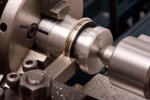
The profile tool ought to remove the plating across the width of the tread in one go. If some plating remains, the tool is not orthogonal to the lathe spindle and needs to be squared up.
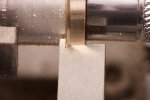
As the profile tool reduces the height of the flange, it cuts away the distorted metal.
 I use the profile tool to remove all of the plating, and then a further 0.08 mm of metal. Just enough to make sure the wheel is concentric on its mandrel.
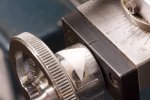
Then mark the setting of the hand wheel on the cross slide.
It is then straightforward to leave the mandrel, leadscrew and cross slide untouched, and use the cross slide to form the treads of five more driving wheels.

Put a tiny bevel on the outer edge of the tyre. I make this about 60 degrees, and about 0.015 mm deep front to back.
The bevel removes any tiny pieces of metal pushed over the edge during the profiling operation. The bevel also represents a feature present here on a prototype wheel, though I haven’t checked the detail on a real class 45.
Guess what - do this for the other five driving wheels.
It is now time to finally remove the faithful mandrel, set up the smaller mandrel and complete the two smaller wheels. Maybe it is me but I found the smaller wheels even more difficult to turn. The grade of brass grabs and chips and I was on the verge of stopping to buy four new disc wheels. But I persevered.

The wheels are now ready to be cleaned, blackened and put back into their bogie.
Measure the diameters of all the wheels, and put the smallest one back onto the mandrel.
The deformation of the flange I mentioned earlier becomes more obvious when seen beside the profile tool.
The profile tool ought to remove the plating across the width of the tread in one go. If some plating remains, the tool is not orthogonal to the lathe spindle and needs to be squared up.
As the profile tool reduces the height of the flange, it cuts away the distorted metal.
I use the profile tool to remove all of the plating, and then a further 0.08 mm of metal. Just enough to make sure the wheel is concentric on its mandrel.Then mark the setting of the hand wheel on the cross slide.
It is then straightforward to leave the mandrel, leadscrew and cross slide untouched, and use the cross slide to form the treads of five more driving wheels.
Put a tiny bevel on the outer edge of the tyre. I make this about 60 degrees, and about 0.015 mm deep front to back.
The bevel removes any tiny pieces of metal pushed over the edge during the profiling operation. The bevel also represents a feature present here on a prototype wheel, though I haven’t checked the detail on a real class 45.
Guess what - do this for the other five driving wheels.
It is now time to finally remove the faithful mandrel, set up the smaller mandrel and complete the two smaller wheels. Maybe it is me but I found the smaller wheels even more difficult to turn. The grade of brass grabs and chips and I was on the verge of stopping to buy four new disc wheels. But I persevered.
The wheels are now ready to be cleaned, blackened and put back into their bogie.
Last edited:


 ) is continuous cast iron. It turns very easily, but do protect your lathe from its swarf and dust.

