D869's Occasional Workbench Thread

D869Zest

Active Member
I've been intending to start a workbench thread on here for ages but I have many good intentions... but here goes.

Having posted a thread a few months ago on the topic of protecting decals I thought it would be logical to post some pictures of the wagons finished after these tests. Decal-wise these were all protected with Tamiya Flat Clear Lacquer applied by airbrush.

All of the wagons are from 2mm Association kits, trying to expand my 1940s era 'run of the mill' stock to populate the earliest era that I intend to portray on Hayle North Quay.

The photos are a bit noisy sorry. Really should have waited for better light, but then the thread would still not have got started.

A slope sided steel mineral. This one turned out to be quite a tricky one to put together, getting the body to integrate nicely with the chassis being the main challenge. Even after packing out the floor to make it wider and a lot of other fudging it is not a perfect fit.
P1080846.jpg

LMS 5 planker. Mostly straightforward but a fair bit of work needed on the buffer beam to make it look like a rectangular piece of wood instead of a tapered plastic moulding. The buffer holes in this one were also too big so needed to be filled with plastic rod and redrilled.
P1080843.jpg

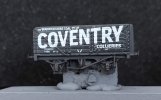
My personal favourite and my first attempt at reproducing a prewar private owner livery with wartime livery changes. The RCH 7 plank kit is quite an old one in the Association catalogue and needed improvements in terms of a replacement floor, extended curb rail, scribed planks inside the body, diagonal ironwork scraped off and added on a more correct alignment, new end door hinge bar, steel end stanchions replaced with 'wooden' (err... plastic) ones.
P1080844.jpg
 

D869Zest

Active Member
Still buildin' wagons. I can do other things too but I kinda need more wagons for Hayle... hence knocking these out largely as their designers intended...

First up is the 1950s era Toad for Hayle. I do have a (very!) less than perfect photo of the real thing so if I have read the number correctly (which is far from certain) then the identity and branding on this one are about right. It's a 2mm Association etched kit that has since been discontinued. I started it at the Association weekend workshop last October. The chassis went together on the first day. The body took rather longer, not that there is anything particularly wrong with the kit - it just involves a lot of work. The roof is not as light as it looks in this photo but it does need a bit more crud next time the airbrush is suitably loaded.

IMG_20250519_135038.jpg

The other two are some pretty run of the mill LMS wagons for the 1940s era. Another 5 plank open, but in bauxite this time, plus the van, the kit for which which has been sitting unloved in my boneyard box for literally decades. It needed quite a bit of filling and fettling around the corners (which is why it had been laid aside). I added the extra ironwork on the left hand panel to match a photo in Geoff Kent's 4mm wagons book. The light today has also made these two look less grubby than they do in reality.
IMG_20250519_135223.jpg

Finally some older news - the AA3 Toad that will be doing service in the 1940s era in a comparison shot with its younger cousin. Britain from Above has some late 40s photos of Hayle which caught the branch goods in the act and on the tail end is a Toad with the chimney firmly on the centre line. The branding is about right as far as I can tell from the fuzzy images but the number is a complete guess. This is another now discontinued Association etched kit... and also took a long time to put together.
IMG_20250519_135343.jpg

I will try to find something less wagony to share next time.
 

D869Zest

Active Member
As promised, something less wagony...

For some time I have had a liking for the idea of being able to make wheels myself from scratch... not that I have a huge need to do this but it still seemed like the sort of thing that it would be good to be able to do. A fairly thin excuse to try it out arose recently so this was far more interesting than the things I ought to be getting on with.

Some time back I bought a Tomytec chassis online from Japan intending to use it under a multiple unit. Having taken a closer look at it I found that two of the wheels had traction tyres... which is pretty much a no-no for me when thinking about reprofiling to run on 2FS track. No problem... I will make two new plain disc, non insulated wheels - ideal, only two wheels to make and pretty much as simple as they can be.

I've read up on numerous ways to do this but my thinking was to make a simplified form tool just for the tread and outer face of the flange, reasoning that I was quite happy forming the rear and tip of flanges using a parting tool and files when reprofiling 'N' gauge wheels so I could do the same when making wheels from scratch. I cheated slightly by simplifying the flange face to a straight line at a compromise angle.

In the olden days I was shown a thing called a shadowgraph for magnifying and checking profiles on tools and such like. I don't have one so I decided that the mobile phone camera would be its modern substitute.

profile-check.jpg

On the whole the lathe job went to plan (nice, since I'd spent so long working out the flipping plan!). Drilling for the axle was the only iffy part. Trying to use a small centre drill in the tailstock was hopeless so after a rethink I set up my small boring tool (a recycled 3mm milling cutter) on centre height and at 45 degrees and made a pimple with that. The 1mm drill still wobbled a bit but after some peck drilling it stabilised and all looked good. The fit on some 1mm axle steel was a bit variable but usable so I think I got away with it.

turning-wheels.jpg

Having ended up with two plausible looking wheels I turned my attention back to the Tomy chassis... at which point the plan fell apart.

On my initial inspection of the Tomytec chassis I had assumed a few too many things. On a second inspection prior to starting on reprofiling the wheels I discovered that the wheels and pinpoint axles were in fact all one lump of metal so moving the wheels outward was simply not going to fly.

tomy-wheel.jpg

The second problem was that what I'd assumed were 1mm axles were in fact 1.05mm axles so 1mm axles were too loose a fit in the Tomy gear muffs. After some further thought I decided that this had now ceased to be a simple finescale conversion and that the Tomy chassis would remain as its maker intended and would be heading for a well-known online auction site.

I still wanted to know if my newly made wheels actually worked so that the exercise was not a complete waste of time. After sleeping on the matter I remembered an Atlas GP7 that I had bought on a trip to the US and rewheeled a long time ago with NWSL 40 inch/64 wheels. The Atlas axles are properly 1mm so the GP7 could play host to my newly made wheels. I made up a second pair to prove to myself that the first wasn't a fluke, mounted all four on 2mm Association pinpoint wagon axles cut in half and assembled them onto the Atlas gear muffs.

wheels-and-muffs.jpg

Actually it wasn't quite that simple - I'd made quite wide bosses because the Tomy gear muffs are not very wide. The Atlas muffs are wider so I had to reduce the bosses by mounting the wheels backwards on an axle and holding that in my watchmaker's lathe. I also found that I'd left some flanges a bit too thick so these were thinned further while the wheel was on the watchmaker's lathe.

atlas-bogie.jpg

So did the new wheels work? Absolutely! - not so much as a bump or wobble when traversing some pretty questionable point geometry on my micro layout 'South Yard'.

GP7.jpg

I do think the C&NW livery is very snazzy, even if it is a bit out of place on a long forgotten ex LSWR branch line in Plymouth.
 

D869Zest

Active Member
A few more wagony words...

I'm still working on building up my 1940s fleet of 'also rans' - mineral wagons, opens, vans and so on. Not super exciting but necessary. The latest tranche is now part way through the painting campaign and I thought it might be worth a few words here.

Back in the first post on this thread we saw the Hickleton wagon but I didn't go into any detail on how the lettering was done. The new lot has another RCH wooden bodied PO wagon which is just in the process of receiving its lettering. As I've had plenty of good results with custom decals on other types of vehicle I wanted to try the same approach for PO wagons. Step one was to stick a wagon side moulding onto the scanner and then import the image into Inkscape and scale it to actual size. Add a semi-opaque rectangle resembling the body colour then find a font that is not too far away from the hand painted lettering on the real thing...

1773769196197.png

Then (bottom to top, sorry!) fit the lettering to the space on the wagon side (avoiding the corner strapping), transform the text into a 'path' (just a bunch of lines and points) and mess with any letters that don't match the real thing - in this case mainly the 'I' (easy), 'C' and 'O' (not so easy) but I think I made the others a bit skinnier too. Finally create another copy of the lettering, colour it black, offset it down and right and put it behind the white text before adding in the other smaller stuff to finish the job

1773769588341.png

Then the thing is copied over to the final decal artwork sheet, duplicated for the second side (plus one spare in case of damage) and the artwork sent off to John Peck at Precision Decals for printing. I am glossing over a lot here.

The wagon in the current batch is a good illustration of how modelling the WW2 period allows the application of Rule 1 when choosing private owners. They were all pooled so could appear anywhere in the country. This one is from Coventry Colliery - partly because I think the livery is interesting and partly because I actually did a visit underground there on a school trip way back when.

Predictably, applying one big decal results in a pretty poor job at the first attempt...

1773770289462.png

1773770145971.png

But as the Hickleton wagon proved, all is not lost. The other side has started the 'conformance' process with a first application of Microscale Micro Sol (at least a day after putting the decals on)...

1773770073146.png

For round 1 I concentrated on the fit around the main ironwork, brushing the softened decal into the corners and trying to smooth out any bubbles (not without missing a few it seems). I also made some scalpel cuts in gaps between the letters close to any strapping. Another one or two rounds to go, including getting more assertive with the planking lines. There are also more decals to go on once the initial big one has been persuaded to behave in a reasonable manner.

Another wagon is a Hurst Nelson Associated Octel 14T Chlorine tank which has been in the pipeline a long time having been rather forgotten while half finished. The plan is to finish this in the final compressed gasses livery seen before Hayle closed - namely white with the horizontal orange band at waist level. Drawing a horizontal band around a cylindrical tank with domed ends will probably be tricky but I intend to try using a bow pen to offset from a straight edge with the tank sat on its saddles. I'm going to try lining with Humbrol enamel in spite of known issues over Shapeways Detail Plastic - I hope the primer layers and Tamiya gloss white will be sufficient to prevent any bad effects.

If it goes horribly wrong it will be stripped and repainted in the earlier livery with red vertical stripes. I know I can do that one.

My first task was to try to find a suitable colour, having nothing very orangey in my paint box. The actual prototype colour seems to vary a lot, partly due to variations in painting and partly because the colour seems horribly prone to fading. The 1970s Octel tanks seem to have quite a warm yellow shade rather than a more vivid reddish orange seen on, say, later ICI tanks. I painted up some scrap plastikard swatches. The one on the right is getting there colour mix-wise but is much too dark so more swatches will be happening.

1773770806506.png
 

D869Zest

Active Member
Painting and lettering is ongoing.

In other news... always an exciting moment to get a delivery from PPD...

IMG_20260326_124217a.jpg

A few re-runs on here with minor changes but more than half of it is new stuff (1940s tank wagon chassis mainly) so hopefully I haven't made too many howlers.
 

D869Zest

Active Member
Another job that I have finally got around to starting... I've been concerned for some time that I don't have a suitable loco to pull all of these 1940s wagons that I'm building.

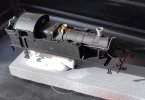
I hit upon a shortcut to this. A few years back I built a David Eveleigh 45xx chassis and put it under a lightly modified Dapol body in the guise of 4574 in late BR green as seen in photos of the final days of steam in Devon. I have also bought a second 45xx body (from DCC Supplies IIRC) so I hatched a scheme to backdate the second body to 1940s GWR livery and borrow the chassis from the green 4574.

I'd also done some extra 45xx numberplates when I did a batch of 8 thou brass etches with PPD. Having checked the available numbers and compared with BR Database to see what was in West Cornwall in the relevant period I came up with... 4574.

The Dapol cab is noticeably too high. Having checked the drawing in GWRJ 16 I think the main issue is that the cab roof radius is too small. Not an easy thing to fix short of making a whole cab top which would have defeated the object of trying to get something done quickly. Instead I borrowed Ian Smith's idea of filing down the tops of the cab side sheets as far as possible... which is not very far - perhaps 0.4mm at most but it is still an improvement.

The next issue was that the bodyshell lacked a chimney and the fender around the lamp on the bunker top.

The chimney was turned up on the Unimat... twice because I messed up the first one by drilling the hole too deep so it came off the bar stock prematurely when I was trying to form the spigot that locates it into the Dapol moulding.

The two 4574s together with the offending first attempt at making the chimney...
IMG_20260329_214242.jpg

Next job is the fender. I cut a strip of 5 thou brass to the right height and then experimented curving this around a 2mm drill. I needed some card packing to stop the fender recess being too deep. Several bits were glued together to leave a slot for the drill to sit in. Then the brass was laid on top and pressed down either side of the drill using a couple of steel rulers. On the third attempt I think I got the packing depth about right...
IMG_20260329_214125.jpg

The end bits were then cut off at 45 degrees with a knife and the top profile filed to look something like photos of the real thing (the GWRJ drawing being too early to include the fender). I still need to add the beading and figure out how I will attach it to the bunker,

Plenty more odds and sods to sort out - like losing the smokebox numberplate, maybe improving the handrails and making some new rear sandboxes. I was organised and wrote myself a list of jobs... and then lost it.
 

Matt.S.

Western Thunderer
Great to see you at the digital bench Andy, that's an eclectic set of tanks.

I can't quite place that bottom centre etch though -
 

D869Zest

Active Member
Great to see you at the digital bench Andy, that's an eclectic set of tanks.

I can't quite place that bottom centre etch though -
Not that eclectic... just stuff that ran to either the bromine works or Esso depot at Hayle, mostly 1940s on this etch.

The 'L' shaped bit is whatever I could fit into the leftover space. Some bits are to try to keep moving (very slowly) forward with another wagon - a 1967 vintage Charles Roberts bromine ferry tank. This will be the fourth etch I think containing my trial and error efforts to see what might work, the catwalk being a particularly tricky beast. The other bits on there are bog standard DSI brakegear bits to try to speed up some aspects of building bog standard DSI brake equipped wagons.
 
Top