Thank you Simon, will do! I'm committed now anyway - or some think... oh, never mind!
I have read the horror stories, and seen the graphic illustrations of what bar rail can do to innocent tyre treads and flanges... and I do agree! I cannot help wonder quite what the offending bar profiles were that caused such catastrophic damage though? Therein is something of a puzzle, considering that bar is used so commonly, especially in 5 inch gauge - where not just a few are club/public railways, and upon which quite high mileage can be expected. With all of that said in mind, the bar I chose to purchase was not just based on local availability and cost, but when I inspected it in the shop, was extremely pleased to note the depth of radii at the top and bottom edges! I am also hoping that having the rail alignment set directly in the path of maximum vehicle and regular pedestrian traffic might help to keep the heads slightly smoother as well?
I have to accept that my oddly various use of materials for wheels is bound to be problematic over time anyway!
Thank you too for your suggestion Brian McK. That rather severe reverse curvature on the main line is niggling away at me also since I installed - and travelled quite a few times over it!
The problem is not just the proximity, and clearances between fixed structures - or rather those which would require further serious physical effort (and expenditure) to modify, but practicality too. Oh how I wish it were possible to cut away part of that end slab as you have indicated... but as the following image attests:

The slabs are effectively hollow, with rebars in the external "frames" only - and none in the relatively thin centre panels. Although they were clearly not designed for such, they have proven to be perfectly durable when walked, run and jumped on for over thirty years! Cutting a slice off the corner of one would I fear be a different matter, for not only would I have to hire an industrial disc cutter specifically for the task, but I fear the result might severely affect that vital structural integrity? We do have one that was square cut in half, (done many years ago) but the section re-used still retains the thicker, central brace.
Please be assured that I am giving serious consideration to the issue though, and so far I have concluded that with a bit of extra jigging, there is still just enough space to reduce the severity of those curves (and slightly improve passenger comfort) later.
I find myself, as previously mentioned, under increasing pressure to complete the extension westwards, as other promised assistance with the remaining major structural and landscaping works etc., is, I am informed in no uncertain terms, relying entirely upon that!
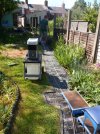
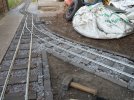
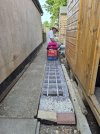
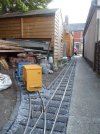
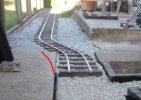
Yesterday, yet another small (ish) step, or maybe wriggle toward the ultimate goal was achieved:

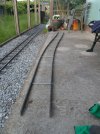
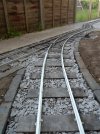
Yup! Yet another one of those bloomin' swerves! If I were not a glutton for punishment enough?!
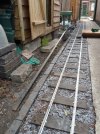
This time admittedly, it is a slightly gentler affair - but I am relieved to say so in more than the obvious way: That bar might not look much - and almost appear naturally capable of bending all by itself...
Oh yeah?!
That it is made of steel is only thing I can be absolutely sure of... What kind is a whole other matter! Would it bend? Oh yes... Would the bend stay in it?
Ha, hah!
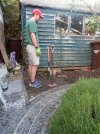
There was an awful lot of grunting and bashing... plus copious swearing. On a couple of occasions I was concerned that if were were not careful, I could end up on the station roof or hanging from a branch in one of the trees!
The agonising result is still a tad thruppenny bit in a few places... but that is the absolute best I could manage - and just as far as I was ultimately prepared to go with it!
It should, under the ridiculous circumstances, do quite nicely though...
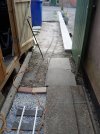

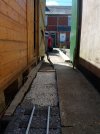
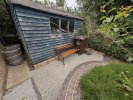
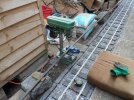
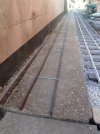
Unfortunately, the joint here between the two sections is in a frustratingly awkward spot in relation to the Goods Shed doorway!
The existing railhead, and short infill section of aluminium will have to be eased in toward the path to align. I cannot extend the concrete any further than the steel, and without having to go in search of an additional offcut of similar bar, might instead have to install "crossing timbers" at the intersection to form a flush step beneath the doors.
After a brief recovery break, the next task therefore is to work out how to make up some rather complicated shuttering.
Pete.















 ...........I'm gone.