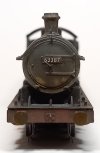
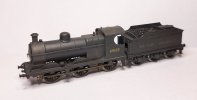
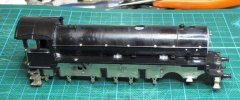
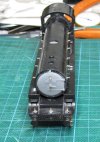
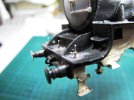
B1 - 61161

Dave Holt

Western Thunderer
0.27 mm for Gibson medium (2 mm) knobs, according my trig.
However, there are two holes in the cab spectacle plate that locate the ends of the hand rail and these are much closer (approx 1.325 mm - I can just get a 1.1 mm drill bit between the hand rail wire and the boiler) to the boiler than the medium knob standout so I'm going to use Gibson shoulder-less knobs. The shank of these is 0.6 mm diameter, so the 0.65 mm holes I've already drilled are slightly oversize, but not enough to warrant plugging and re-drilling - just plenty of glue.
The drawback with these knobs is that they have no mounting flange (by design) but I've found some custom etched washers (1.3 mm diameter, 0.125 mm thick) that will represent the flanges on the boiler. There should be 13, including the front of the smokebox, but unfortunately one pinged off and defies being found, so the front will have to manage without.
 

Dave Holt

Western Thunderer
Oft laid plans, etc.....
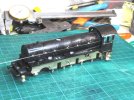
A washer was placed onto the shank of the first handrail knob and cyno glue applied inside the drilled hole then the washer fell off the knob to be lost in the carpet. Now there were only 11 available so the knob was inserted without. Oh well I'll just have to live with it. The left hand side now has all the knobs fixed in place and has a temporary piece of handrail wire fitted in the photo. Consistent stand out from the boiler was achieved by using a suitable drill shank as a spacer/gauge. Height above the foot plate was checked with another simple sheet metal gauge but was in any case set by the drilled mounting holes.
B1_093.JPG I'm more and more taken with the split handrail idea when I come to do the actual rails. I've never tried this approach before, but it could be much easier than trying one continuous rail round the front and down both sides. However, the ball on the front stanchion isn't going to provide much land to locate the ends of the separate rails.
Dave.
 

Dave F.

Western Thunderer
Hi Dave, on my B16 and others I made a handrail joint on the third knob down the boiler on both sides so there are two straight lengths down the boiler sides and that leaves a quite manageable piece to make up for the front end. I soldered the straight wires half way through the third knob and made the front portion over long to allow for the bending then slid it through the first two knobs and marked it for cutting, again slightly long and then filed the wire to exact length attached the shortest knob I could find for the smokebox and checked the alignment again and soldered it all together. Just a tiny touch of the soldering iron on plastic models though.
Hope that helps,

Dave F.
 

Dave Holt

Western Thunderer
Thanks, Dave. To me, the difficulty in the type of handrail fitted to the B1 is getting the front radius and corner radii in exactly the right relationship such that it ends up symmetrical and with the parallel legs along the boiler the correct distance apart. Although your methods reduces the length of wire being manipulated, I'm not sure that it really helps with the problem that I foresee.
Dave.
 

Dave Holt

Western Thunderer
Thanks, Simon. They're lovely looking models despite cruel enlargements of 2 mm scale models. Beyond me. My eyesight just wouldn't be up to modelling at that scale.

Some further progress with the B1.
The RHS boiler handrail knobs are now fitted and I've also fitted the smokebox door and the front lamp irons. These latter are not the usual shape as they were designed to allow electric lamps to be fitted below the normal oil lamps, although this loco never received the electric equipment.
RHS of boiler.
B1_094.JPG
Smokebox door and front lamp irons.
B1_095.JPGB1_096.JPG
A more detailed view of the lower front lamp irons.
B1_097.JPG
I have a horrible feeling that the smokebox door is not fitted quite right in that there is a sense that the hinge pin is not perfectly vertical. It's almost imperceptible when checked against the footplate using a ruler but I'm not sure whether I need to replace it. There's no chance of getting the existing door off without destroying it so I'll see if I can live with it.
Dave.
 

LarryG

Western Thunderer
I stopped building loco kits commercially around 1979, but even in those days I never used handrail knobs. Such items are probably a lot smaller nowadays though. I squeezed small split pins around the handrails. An advantage was the pins allowed a bit of vertical bending on boilers when my handrail holes weren't absolutely in the right place. Also, they could be long or short depending on how far they were pushed into a boiler to accommodate Belpaire fireboxes and non-flush smokeboxes.
 

Dave Holt

Western Thunderer
Thanks, Larry. I've seen split pins used as handrail knobs on various models and the shoulder-less versions I've ended up using have the same advantage in terms of infinitely variable length. These particular ones have quite small balls for the rail to pass through. I normally use machined knobs on my usual fare of ex-LMS and BR Standard locos, as the various lengths available suite.
On the B1, I noticed that the smokebox door wasn't fully seated onto the front of the smokebox near the hinge and by very careful use of of my scalpel I was able to prise the door off without damage. After cleaning up the surfaces it was re-attached using 5 minute epoxy, rather than cyno, which gave some adjustment time. The difference is tiny but I'm much happier with the door orientation now.
B1_098.JPG
Funnily, to my eye, it still doesn't look quite right in this photo, but using the "crop" cursors on my photo editor, it is absolutely spot on for both hinge pin and door hinge straps compared with the top of the footplate and buffer beam. Some sort of optical illusion.
Dave.
 

P A D

Western Thunderer
The contrast between the door and the ring are possibly contributing to your feeling that it's not quite right. When it's painted you may see it differently, but it looks spot on to me.
Cheers,
Peter
 

Dave Holt

Western Thunderer
Thanks, Peter.
I had started to make a brass replacement for the ejector discharge pipe along the LHS of the boiler but then re-appraised the original Bachmann moulded plastic version and decided to see if i could improve it by scraping off the moulding flash. I thought it actually looked perfectly useable, so it has been refitted. Also made, but not yet permanently attached, is the drain pipe for the ejector pipe. Compared with my more familiar Stanier and BR Standard types, the drain pipe does not run outside the smokebox all the way from the front elbow but starts inside the smokebox and emerges part way down via a small external elbow - represented by small bore brass tube.
Original plastic discharge pipe in situ.
B1_099.JPG
Close up of the drain elbow and pipe.
B1_100.JPG
Dave.
 
Top