A Garden Railway Pipedream: the odyssey continues

AndyB

Western Thunderer
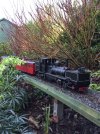
I went down the route of running the track at ground level, partly because I think it looks more realistic but also partly because it is less obtrusive in the garden and Mrs B was prepared to tolerate something at ground level but not structures three feet in the air. I’m sure as I get older I will regret it but at the moment it is a great height for the grandchildren to watch the trains go by…


Nigel
My garden slopes, so from just above ground level at the back of the house it is 4ft above ground at its highest point.
Steel structure from scaffold poles, backer-board top on 100x50x2mm galvanised angle. The steel was all free (scrap), except for a length of 25mm box section used for the leg braces.
 

simond

Western Thunderer
Ground level is always going to look nicer, but is not really an option as the layout inside the shed is going to be 3 or 4 feet above ground level and I ain't digging a hole to build the shed in!!!!
 

Dikitriki

Flying Squad
Hello Simon,

If I was going to do anything different, I would have gone for a heavier duty cable tray which would deflect less. The granite chippings ballast was very heavy and I hadn't factored the weight in. I wouldn't rely on the Backer Board carrying gaps, though as you are considering a 7mm scale layout, you wouldn't have such a great span.

Pluses. No wood at all. Height adjustable. Relatively easy to dismantle and replace a section (necessary when tree roots caused a problem). The line over-wintered extremely well, and there was no maintenance required prior to the first run.

Minuses. Cost. Backer Board is a sod to cut and shape, and impossible to paint successfully. Boards seem to vary in the edge friability, and must be treated with ballast adhesive or similar to seal the edges. It took us some years to arrive at an optimum (for us) outcome.

General. the layout has stood the test of time so far and is showing no signs of material degradation. We may have to replace a couple of the boards this spring due to the edges breaking up, but we didn't get time to fully ballast and prepare them last year. I know you are some way away, but if you wish to see for yourself, you would be welcome.

Richard
 

simond

Western Thunderer
Richard,

thanks, both for the review & advice, and for the kind invitation.

I did a quick tot up today and was a little surprised to find myself looking at around £850 for a relatively short line and balloon loop, so the cost is certainly worthy of consideration, and I haven’t looked for the best deals yet. But in any case, if it lasts 10 years, it’s peanuts. At least I know I can do it this way.

I’ll need to get the shed sorted first.
thanks again
Simon
 

David B

Western Thunderer
I very much hear what you‘re saying about wood Simon, as well as the challenge of your location by the sea - but it might be worth reconsidering, depending on how long you want the new line to last and whether the techniques used on your late friend’s line could be changed. At my last house, the slope of the garden meant that half of the line was above ground and half was at, or slightly below, ground. For the above ground section, I used met posts to support the tanalised uprights and prevent any part of the wood touching the soil, with treated decking boards on top, strengthened at the edges by cheap fence capping strips. I didn’t use any kind of roofing felt on the boards - the ballast was simply loose on top. I gave the line no further treatment and when we moved after a decade and I dismantled the raised section, there was no rot anywhere. Rightly or wrongly I’ve put this down to the prevailing south-westerly wind which blew straight down the garden and dried everything in its path - soil, pots, clothes on the washing line and my railway. My wife has always worked on the basis that many things (cuts, grazes, blisters, drying washing, gossip, etc) are much best dealt with by ‘letting the air get to it’, and (barring any other suggestion), I think this is probably the most likely ‘Occam’s Razor‘ explanation here.

Our new home was more of a challenge, as the only space for a railway was at the bottom of the garden, within 6 feet of a stream that regularly overflows in winter, so the basic soil and air conditions are pretty damp. However, the prevailing wind is still south-westerly, so I thought I’d take a punt on using the same basic construction techniques, but modified to build in extra steps to avoid moisture traps. So far the main section of the line has been in place for 8 years and I haven’t yet found any signs of damp in either the posts or the boards. The changes I made were a) to impregnate all cut ends on the tanalised uprights with cheap superglue, b) to replace the upright-to-baseboard butt joints with inverted plastic decking feet, which had the benefit of giving me the ability to adjust levels precisely, and c) using galvanised washers to create air gaps between the plastic decking feet and the boards above. I was worried that the torrential rain of the last three winters would have done serious damage to the construction, but so far the only casualty has been endlessly disappearing ballast (mainly due to heavy rain, but in part down to my hens who like to use it to top up their crops).

There’s a couple of downsides to all this - firstly the boards seem to need one full season to settle down properly, but once they do, the trackbed has been completely stable, taking the 10-12kg weight of my Earl of Merioneth or my NGG16 and the same weight again in carriages. On one occasion, the full length of the line supported the weight of a fast-moving mature muntjac with no problems or damage. And secondly, while the regular expansion and contraction of the wood during wet and dry spells effectively makes no difference to the running of the trains (because, I think, the tolerances in the plastic decking feet allow for some flex), it’s a complete nightmare if you want to incorporate a removable section or a lifting bridge.

Here’s a few gratuitous photos:
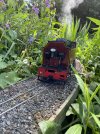
IMG_0803.jpegIMG_0812.jpeg

IMG_0564.jpegAnd lastly a photo from my previous line showing how lonicera nitida covers a multitude of my constructional sins (while still ‘letting the air get to it’):
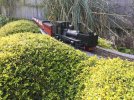

IMG_0188.jpeg
 

Rob Pulham

Western Thunderer
I know there seems to be a big fear of wood rotting for outdoor railways but modern tanelised woods are very resilient.

At our last house we had a stream running down the bottom of our garden with quite sloping banks. To maximise usable space in the garden, we sank tanelised 4 x 4 posts into the stream bed and used them to support decking. It was still rock solid 20 years later when we sold the house.
 
Last edited:

James Spooner

Western Thunderer
I think it is worth checking how the timber has been treated. At one time preservatives on wood were pretty effective but then the EU came up with a series of regulations banning certain substances from wood preservative as an environmental measure. The chemists hadn’t been consulted far enough in advance so the substitute preservatives were far less effective. On the FfWHR we have been replacing fence posts treated with the less effective preservative when posts were under ten years old but had rotten right through…

Nigel
 

JimG

Western Thunderer
Just to add another garden baseboard method which I used some ten years ago. It consisted of using square plastic water pipe set in concrete in the ground and these were topped with wooden framework to take the plywood track base. The method starts here in the thread I ran in WT


Unfortunately, many things conspired over the years to prevent getting the layout into working order, but the basic plastic pipework and treated wooden framework has survived very well in that period.

Jim.
 

Dikitriki

Flying Squad
Hello,

It's been a while since I posted. Not that I haven't been incredibly busy on the modelling front, but more that I have been working for some time on new projects that are only now beginning to bear fruit. Anyway, we had a lovely day running in the garden yesterday, and Andrew60 (1/32 finescale in the garden) spent a very convivial day with us. He brought his finescale class 22 and a full brake to try out, and somewhat to my surprise given his more exacting wheel standards, there were no problems whatever through the mail line pointwork. We will have to tweak the running lines in one location, but other than that, a spectacular success, which opens up the possibility of other finescale visitors.

I had also spent a couple of very long days getting an inherited class 22 working properly (only ever an unpowered shelf queen) and we had the opportunity to run both 22s at the same time and there was a distinctive Western feel. Photos by Andrew and Dan to mark the occasion.

Andrew's 22 in blue

1000049233a.jpg

Mine in green

1000049235.jpg

IMG_7201a.jpg

Both together.

IMG_7195a.jpg

IMG_7203a.jpg

Dan's pannier and B set.

IMG_7207a.jpg

Cheers,

Richard
 
Top