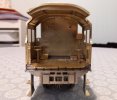
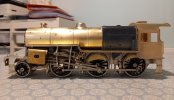
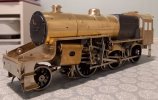
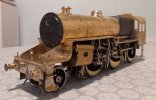
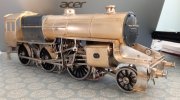
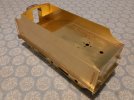
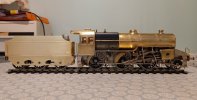
7mm Gladiator Horwich Mogul

P A D

Western Thunderer
Many thanks Gary. Glad you like it.

This afternoon I found a lamp iron on the draining board where I left it yesterday after knocking it off while scrubbing the running plate with Bar Keeper's Friend. Note, the nearside iron is missing in the last but one image. After 40 years building brass kits you'd think I could solder by now! :D

Anyway, it's back on, hopefully better fixed than the first time. Didn't get much done today as I was too knackered after our usual Wednesday walk in the Dale's, but I did get the roof formed and the internal bracing and roof vent added.
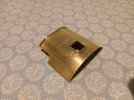
20251126_221148.jpg

Nothing came off this time after scrubbing it!
20251126_221137.jpg

Hopefully I'll complete the cab tomorrow and make a start on the firebox, boiler and smoke box. Fingers crossed it will start to look like a locomotive before long.

Cheers,
Peter
 

Ian@StEnochs

Western Thunderer
Nice work Peter, especially that cab roof.

I find bending a multi curve roof out of a half etched tee shaped piece of metal very challenging. You only have the cab front to use as a former. The stiffening ribs are fine at keeping it in shape but unless the roof is correct they are easily distorted. When I built both a Mogul and a Scot both roofs caused me grief, I am happy that most of my preferred prototypes have simple arc roofed cabs!

Ian
 

P A D

Western Thunderer
Thank you Ian.

Fortunately, the cab parts went together without hassle as did the rest of the cab.

Here's the assembed cab after fitting to the running plate.
20251128_132755.jpg

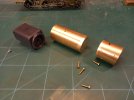
The rest of the upper works are a mix of a resin firebox, etched boiler and smoke box and resin smokebox ring and door. Here they are the ready for assembly.
20251128_160558.jpg

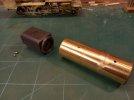
The smoke box and boiler are bolted together.
20251128_161456.jpg

And then epoxied to the firebox.
20251128_163639.jpg

The firebox is then fixed to the cab via two self tapping screws throught the front plate, and the smoke box soldered to the running plate at the other end . I couldn't resist taking some images with the tender from the Stanier Mogul.
20251128_183412.jpg

An impressive beasty methinks.
20251128_183206.jpg

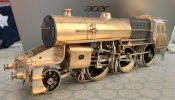
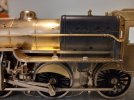
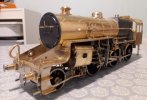
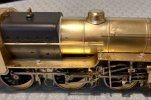
And after fitting the footsteps.
20251129_210604.jpg

20251129_210720.jpg

20251129_210616.jpg

20251129_210653.jpg

The cab splashers are cast brass. Unfortunately the one on the left side is distorted and lifted slightly. I'll close the gap later with filler.
20251129_210537.jpg

Next will be the chimney, dome and smokebox door and then the fiddly bits.

Cheers,
Peter
 

P A D

Western Thunderer
Many thanks John.

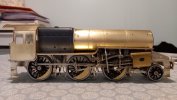
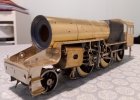
With the chimney and dome added the basic profile of the locomotive is complete.
20251130_214539.jpg

20251130_214427.jpg

20251130_214402.jpg

20251130_214345.jpg

I've also added the smokebox ring and door.
20251130_214509.jpg

As well as the cover for the cab roof vent.
17645395809905894752894215975163.jpg

I've realised I need to add the steam feeds to the sand pipes as well as the missing ashpan. I'm in two minds whether to press on and add all the detail fittings to the loco or make a start on the tender.

Cheers,
Peter
 

P A D

Western Thunderer
Hi Arun,
It's a modified Slaters' bush. I tap the bush 10BA and drill two 0.7mm holes in the flange. Add a 10BA washer then the rod and screw the bush on in reverse. I tightening it with a pair of tweasers and as you don't need a nut, you have more clearance behind the slidebars. It's not my idea and many others on here use it. See post #6.

Cheers,
Peter
 

JeremyC

Member
Hi Arun,
It's a modified Slaters' bush. I tap the bush 10BA and drill two 0.7mm holes in the flange. Add a 10BA washer then the rod and screw the bush on in reverse. I tightening it with a pair of tweasers and as you don't need a nut, you have more clearance behind the slidebars. It's not my idea and many others on here use it. See post #6.

Cheers,
Peter
If you drill the two holes close enough to the tapped hole (I put a steel screw through the bush and drill down the side of it) you can use a Romford/Markits wheel nut screwdriver to tighten them.
 

P A D

Western Thunderer
I wonder if we need to start packing a pair of threaded bushes with this kit? We do it for some others where essential (8F, H2....)

David
Would be good David. It's a shame Slaters don't supply them tapped 12BA. I only tap them to 10 BA as the holes are too big to tap to 12. Obviously, a 10 BA nut would be too large on the rear crank pin so I then drill and tap a 12 BA nut to 10, which is more work.

There might just be enough clearance behind the cross head on the Crab to use a filed down nut in the convention way, but I prefer a reversed bush on the leading wheel.

If you drill the two holes close enough to the tapped hole (I put a steel screw through the bush and drill down the side of it) you can use a Romford/Markits wheel nut screwdriver to tighten them.
Sounds good Jeremy. More than one way to skin a cat!
 

P A D

Western Thunderer
Today I made the ash pan sides and added the steam feed pipes to the sanding gear.
20251201_185640.jpg

Here's a closer view. The reversing rod is a brass etch in the kit which I thought looked a little thin. I made a replacement from waste fret from one of the Nickel Silver etches by laminating the brass rod to the nickel and filing round it. The support for the rod is a very nice brass casting.
20251201_185701.jpg

The supplied buffers are Slaters' items. I finally got the grab rails on above the front steps.
20251201_185743.jpg

And the half etched riveted flange around the rear of the firebox.
20251201_190028.jpg

It come in two parts which makes it easier to fit. I decided to fix it with cyano as it is not in a vulnerable position and the heat stick won't come anywhere near it adding the final details.
20251201_190050.jpg

Cheers,
Peter
 

Genghis

Western Thunderer
Would be good David. It's a shame Slaters don't supply them tapped 12BA. I only tap them to 10 BA as the holes are too big to tap to 12. Obviously, a 10 BA nut would be too large on the rear crank pin so I then drill and tap a 12 BA nut to 10, which is more work.

We pack 12BA tapped bushes with the 8F and H2 kits so people can still use the Slaters screws.
David
 

P A D

Western Thunderer
We pack 12BA tapped bushes with the 8F and H2 kits so people can still use the Slaters screws.
David
Hi David,
Are they standard Slaters that you tap to 12BA? My recollection from trying to tap them back in the olden days, is that the hole is too large to take a 12BA thread. Or do Slaters supply ready tapped?
Cheers,
Peter
 

Genghis

Western Thunderer
Hi David,
Are they standard Slaters that you tap to 12BA? My recollection from trying to tap them back in the olden days, is that the hole is too large to take a 12BA thread. Or do Slaters supply ready tapped?
Cheers,
Peter
Peter

We commissioned them specially. We supply 12BA threaded bushes with either a circular or hexagonal (8BA) head. Main diameter is as per the standard Slaters bush. We also have these tapped 10BA and 8BA.
 

P A D

Western Thunderer
That's good to know David.

A little further progress. I used brass tube instead of rod for the thicker hand rail on this side as it allowed me to add the end stops from modified 12BA screws soldered in the ends. The kit provides cast pillars for the ejector pipe on the other side, but not for this side. I made these from D shaped nu-gold wire. I wonder why the works used the thicker rail on this side instead of a standard hand rail? To match the ejector pipe on the other side perhaps, but as you can't see both sides of the loco at the same time, does it really matter?
20251203_104712.jpg

I've also added the hand rail on the smoke box door and the left hand boiler hand rail. The three standard rails have end stops made from brass tube. The kit provides a casting for the cranked end part for the ejector pipe with flanges, but I decided to make the whole pipe from rod. I will add the flanges at the cab end from D shaped nu-gold wire, as well as the ejector pipe pillars and the pillar castings will go in the spares box.
20251203_104835.jpg

Apart from the valve gear which was a bit fiddly due to the nature of the prototype and my own assembly preferences, the kit is really well designed and goes together very easily. Hats off to Mr. Firminger for that and to David Hill for bringing it to market. I'm really looking forward to making a start on the 4P 2-6-4t from the same stable!

Cheers,
Peter
 

Genghis

Western Thunderer
I think I must have made a packing error with this kit as we are supposed to pack sufficient pillars to take the larger diameter rod on both sides…… John Firminger produced an additional casting sprue for this. Sorry!
David
PS Glad you enjoyed building this.
PPS. I have other plans for your services…..
 

P A D

Western Thunderer
I think I must have made a packing error with this kit as we are supposed to pack sufficient pillars to take the larger diameter rod on both sides…… John Firminger produced an additional casting sprue for this. Sorry!
David
David,
My apologies, I found the additional sprue with the pillar castings. I must have had a "wood for the trees" moment.
PPS. I have other plans for your services…..
I am intrigued!

The piping on this side of the loco is now completed.
20251204_195213.jpg

Plus I've added the sandbox filler caps and the inspection cover on the front box.
20251204_195233.jpg

I think it's easier to add the ejector pipe as one piece of rod cranked at the rear, rather than using the casting for the end.
20251204_195243.jpg

There's no steam heating pipe at the front, just the brake pipe.
20251204_195306.jpg

I've now added the cylinder drain pipes which just about completes the external detailing. The pipes severely restrict the side play of the pony truck, so what ever prototype I settle on, I might cut back the pipes
20251204_195333.jpg

I think it needs a boiler band cleat on the front of the firebox.
20251204_195407.jpg

And the injectors and piping to complete. That will just leave the boiler backhead, cab doors and motor and pick ups to finish it off.
20251204_195424.jpg

Cheers,
Peter
 

P A D

Western Thunderer
I got the injectors on today after much head scratching as to the pipe runs. I couldn't find a decent image of either side and the works drawings are t0o complex to fathom, so it's just guesswork.

Here's the live steam injector. It's mounted on the back of the step sp you can't really see it.
20251205_200919.jpg

And the D&M exhaust steam injector on tother side.
20251205_200900.jpg

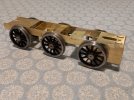
I'm leaving the loco for now and have made a start on the tender. I got the frames together and put the wheels on. It's very simple to put together so no bother there.
20251205_200724.jpg

Instead of completing the chassis I went off on a tangent and jumped to the tender body. I got the basis skeleton together ready to fit the back and sides etc.
20251205_200735.jpg

And placed on the chassis.
20251205_200804.jpg

I've got something on in the morning but I'm intending to pop across the hill to the Wigan show in the afternoon. I'll bring a couple of locos and give them a buzz around on the test track.

Cheers,
Peter
 

P A D

Western Thunderer
Although the loco is a new design, the tender is classic Gladiator dating back to 1994. That said it is well designed and assembles very easily. An inner frame work to support the coal space floor/tank top is added first, followed by the rear and then the sides.
20251207_171115.jpg

Unfortunately, with the inner frame in place the rear and side panels have to be soldered on the outside. Here the rear is soldered up while the right side is just tacked. It's easier to add the steps, grab rails and hand rail in the flat.
20251207_171134.jpg

Both sides soldered and cleaned up. 20251208_172202.jpg

Then the tank top and coal space floor are added. There are half etched grooves on the underside to aid shaping at the first bend, but lower down the parts needs annealing to facilitate a good fit to the support frame.
20251208_172227.jpg

A view of the underside shows the side panel tabs which require a little sanding later. I've removed the rear part of the under frames ahead of the buffer beam to make space for the buffer screw when compressed. The gap will be hidden when the steps go and there is a half etch grooves on the inside to facilitate removal. I will add some additional support behind the buffer beam as it is only butt joined. A point to not that it is best to ream out the holes for the buffers before fitting the beam to the underside of the running plate as it is a real pain doing it in place as I discovered with the Stanier Mogul!
20251208_200753.jpg

I've made a start on the front bulkhead but it is only placed for the photo in this image. As with the Sranier mogul tender, I found the cast part for the top of the coal opening and tool boxes too narrow and have had to cut it at the top to widen it. There's a piece of brass between the white metal on the underside to support the filler I'll use to make good the gap.
20251208_200839.jpg
20251208_200855.jpg

The loco looks good in profile even with the narrow Midland tender, but of course from a rear three quarter view it looks odd.
20251208_201726.jpg

I wonder how it would have looked if Fowler had kept his nose out of the production and it had gone ahead with the original L&Y type tender proposed by Hughes? Images of the Stanier Mogul running in preservation with a Stanier tender show what an improvement that made to its appearance.
20251208_201612.jpg

I had a pleasant couple of hours at Wigan at the weekend and gave my Stanier 3P and BR standard 3 a runout on the test track. To my relief, both performed very well as I hadn't run either of them for a while.

I note that Dapol had decorated samples of the Ivatt class 2 on their stand in BR and LMS black as well as one in the fictitious red livery of the KWVR. The look like they are going to be every bit as good as the BR standard 3! I could see that in the cab the position of the lockers and coal doors have been corrected from the erroneous artwork images posted on the Dapol website, which showed the lockers in a central position when the are offset to the left and the coal doors offset to the right, when they are central.

Cheers,
Peter
 
Last edited:

Ian Rathbone

Western Thunderer
I’ve built a few Gladiator/Andrews tenders and, after the first one, I fit the outsides first, soldered from the inside. The inner supports just need a few untidy blobs of solder to stabilise them and they’re never seen again. I don’t like the white metal coal door cover so I always make a brass one.

It is difficult to get paint above the tender springs so I leave the axleboxes off until after painting and then glue them on.

I am very envious of the invisible solder you use - very neat work.

Ian R
 
Top