4mm Llanfair

LarryG

Western Thunderer
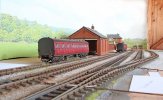
I thought I would share my 'messing around' with members seeing as observations often help me make up my mind. Not being a signalman, I am not sure if a clear view of the line is important at a branch terminus. I presume footplate crews wishing to leave the goods shed & carriage siding could phone the box informing the signalman. The nearer carriage is positioned to show me where the track into the shed will be. (Pieces of paper denote signal box and cattle dock)....
WEB Llanfair trial 7.jpg

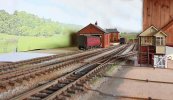
An alternative position for the signal box here. Collecting or ditching the single line token would entail some leg work. Aesthetically, I thought the platform looked bare without the box, which is why I cannot make my mind up on this move.....
WEB Llanfair Trial 7C.jpg
 
Last edited:

daifly

Western Thunderer
Presumably, in addition to visibility, the length of point rodding and signal cable runs would also influence the cabin’s position. The cabin on or near the platform would also interfere with the natural position of an end-loading dock.
It’s your layout but, for me, the big goods shed competes too much visually with the rather fine station building close by and squeezes out the signal cabin.
Dave
 

Focalplane

Western Thunderer
Larry

I assume you will want to run more than one locomotive on the branch at a time which means the signalman will have greater responsibility and will need a clear view of operations. Otherwise, with only one loco (as on the Shipston branch) you wouldn’t need a signal box at all, just a point frame. So I would go with the plan that has no blind spots.

I don’t have my Branch Lines around Oswestry book with me but from what I remember, most stations had their signal box on the platform, assuming operations needed a signal box. In some cases these doubled up as a level crossing box, typically at the end of the platform adjacent to a road, but I digress.

I think it might also be handy to have one or more Whistle boards on the layout!

 

LarryG

Western Thunderer
Diafly, Thanks for that. A plank of timber is representing the platform and there is no end loading there. The end loading facility is opposite the very end of the station. But I get what you mean and squeezing out the tiny signal box is worth looking at. Even in the few hours since i posted, the ground-mounted signal box has grown on me.
 

LarryG

Western Thunderer
Focalplane, Good point about two locos at the terminus at one time. It is these kind of comments (Diafly too), which I hadn't considered, that help me make up my mind. The larger signalbox purchased last week (and scrapped) was intended to be ground-mounted, but I think the box off the platform will suffice. It also means the goods shed wall needs only the statutory clearance from the running line thus leaving more room at the back for lorries and some kidology with the scenics.
 
Last edited:

Pencarrow

Western Thunderer
I think the box away from the station and goods shed looks better. Would give a much improved view of the area. Different railway of course but the LSWR put the box in just that position at Bodmin North. I suspect that the new position would be better for rodding runs etc.
 

LarryG

Western Thunderer
Pencarrow (Chris). Thanks, I missed this earlier. I looked at Bodmin General tonight and there are similarities in the trackwork. After viewing the past few weeks images, the final image is the standout winner with the signal box in its new position. And to think it all started by accident when the goods shed was dumped at the back of the layout out of the way while I photographed coaches. :)
 
Last edited:

Phil O

Western Thunderer
Larry,

There would probably be a boarded crossing from the bottom of the steps to the "mainline" running rail closest to the box for the bobby to safely collect and issue the token.
 

LarryG

Western Thunderer
You're right about the boarded crossing. There will in fact be a railwaymen's walkway from the crossing to the platform. I am just working with as broad brush at the moment to get major buildings positioned. The initial hands-on task will be the lay a new turnout and siding to the goods shed and alter the adjoining headshunt slightly which will henceforth hold fewer coaches.
 

paulc

Western Thunderer
Hi Larry , I've been MIA so have come upon this late . The signal box looks best in the last position . Ref the length of the platform, how many times have you seen a photo of a train that's dwarfed by the platform length . It seems that the designers of stations were always optimistic on customer numbers .
Cheers Paul
 

LarryG

Western Thunderer
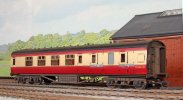
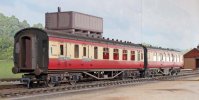
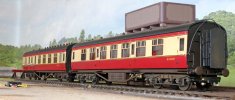
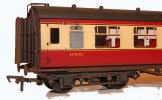
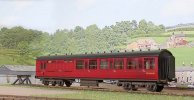
A BR carmine & cream LMS diagram D1968 brake third has been added to the "from another region" fleet. A few weeks ago this coach was BR maroon...
WEB LMS D1968 1.jpg

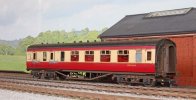
I've gone in for higher slate panels. The corridor connections need more weathering...
WEB LMS D1968 2.jpg

As I have oft' mentioned, these brakes had deeper sides that were welded to the chassis. They overlapped the welded solebars. Welded bogies too...
WEB LMS D1968 3.jpg
 

LarryG

Western Thunderer
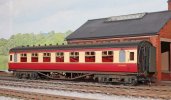
This is the post-war version corridor third with additional doors in the corridor. Tension-lock couplings might only be temporary. It is something I will give more thought to in the future...
WEB LMS D2119 8C.jpg

Welded underframes. Due to acute shortage of materials because road vehicles had priority, some coaches used up parts salvaged from war-damaged coaches. Therefore, window vents, corridor connections and bogies varied.
WEB LMS D2119 8A.jpg
It will be seen that the metal hoods or louvres over the droplights are missing on the model of the corridor third. Metal hoods on metal panels were a source of corrosion and so were often removed and the holes plates over. Most earlier coaches had wood panels and wooden louvres and these were never removed, so one can assume corrosion in this area was not a problem on Period 1 and wood panelled Period II coaches.
 
Last edited:

LarryG

Western Thunderer
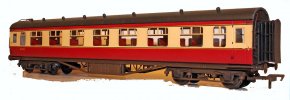
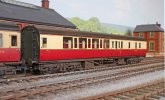
The LMS D1915 is also in carmine & cream livery now. Being 7½ bay excursion stock, these coaches were not fitted with destination board brackets in the cantrail. This model has my own bogie castings because they were there ready-built off a scrapped coach. I still prefer the ones I've been buying in recently...

WEB LMS D1915 5.jpg
The running number is at the LH end. They were applied to the RH end from around 1952 and given a regional suffix letter...
WEB LMS D1915 5B.jpg
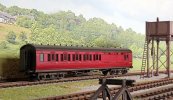
Only one more coach remains in BR maroon, but I am in two minds about this one. It could carry LMS lining and still be correct if it was painted in early 1949 before blood & custard was adopted as the standard BR livery.
 
Last edited:

LarryG

Western Thunderer
A touch of LNWR in GW territory. Diagram D306 corridor brake third. Initial batches were built by the LNWR and identical batched were rebuilt from WW1 Ambulance coaches during LMS days to D1712. This coach retains the original LNWR axlebox covers...
WEB LNWR D306 8.jpg

Having rode in one to Delph, I can tell you those toplight windows made the corridor very light and airy. Most, it seems, carried either varnished LMS maroon or BR carmine red, so BR mustn't have had much regard for them. They were quite prolific until 1954, but had gone by 1956...
WEB LNWR D306 8C.jpg
 
Last edited:

LarryG

Western Thunderer
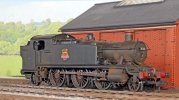
I got around to painting on of my two Dapol Large Prairie Tanks from BR lined green to plain black. For body removal, it was a case of remove smokebox door and unplug DCC adaptor, three screws out and hey presto. Then the cab roof and tool boxes were unclipped. My attempts to remove the lining were aborted becasue of rivet detail.

The body was given a light waft over of Halfords Plastic Red Oxide as a protective shield followed by Halfords Satin black that had been decamped into the spraygun. My weathering 'rust' colour followed using my small spraygun and finally weathering powder. Engraved number plates are on order...
WEB GWR Prarie 4.jpg

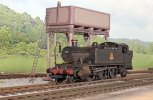
I spent over an hour trying to reassemble the loco, the difficult part being locating the DCC plug inside the smokebox and then plugging in the DC plate through the smokebox front. Then the body would not sit down on the chassis! In fairness, Dapol do state that body removal is not recommended. Rather than go through this again with the green Prairie, it was easier to move the period of my layout to 1956...
WEB GWR Prarie 5.jpg
 

LarryG

Western Thunderer
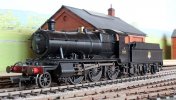
I was spraying some coaches and so it seemed an opportune time to spray-weather the underframes of the Dapol 43xx 2-6-0. Before that though, the wheel rims were painted matt black. The bufferbeams were also toned down a bit. For the moment it is "recently ex works"...
WEB GWR 43xx 1.jpg

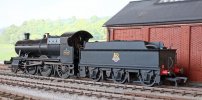
I forgot to mention that no way was I going to dismantle another Dapol loco. The small spraygun I use is basically an airbrush with a spraygun type trigger. It's fine spray and narrow 'fan' enabled me to paint the wheels without affecting the bodywork and so no masking was required...
WEB GWR 43xx 2.jpg
 
Last edited:

Khris

Member
Larry<
could I trouble you to describe the colours used and the way you did the rods please?
They look great!
Khris
 
Top