Reprofiling Slater’s wagon wheels for ScaleSeven

RichardG

Western Thunderer
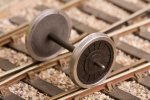
Slater’s do their popular wagon wheels in S7 as well as FS, but there are gaps in their S7 range for example the Mansell wheels. This Mansell wheel is my first attempt at reprofiling a Slater’s wheel.
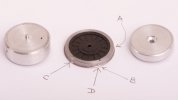
DSC_2543.jpeg
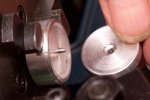
The fixture on the left goes into the chuck, and the spigot holds the wheel concentric. The part on the right holds the wheel in place under pressure from the live centre in the tailstock.

What caused me grief was persuading the tyre to spin. Lots of pressure from the tailstock was not enough.

A. I put a peg of n/s wire through the plastic insert and into the fixture. The lathe was now turning the insert but the tyre kept slipping around it.

B. I put a hole through the tyre but it was too far outside the fixture to connect with it.

C. I put a second hole through the tyre and this worked fine until the profiling tool sheared it off.

D. I put a peg though the tread of the tyre. This worked.

Please, is there a better way? I have read a few accounts of working up loco driving wheels but nothing on wagon wheels. So I don't end up with wheels looking like Swiss cheese.
 

Overseer

Western Thunderer
Did you just use a profile tool? I find turning the extra height off the flange first makes it easier on the profile tool. Some Slaters wheels are not free turning steel and are tough to turn, usually wagon wheels. The most recent ones I turned to S7 were the European 1 metre diameter wheels and they turned easily but I have some standard wagon wheels which don’t respond to the profile tool at all well.
 

RichardG

Western Thunderer
Did you just use a profile tool?
No, I started with the Form 1 tool. I used this to skim the front of the tyre to make it look better, and then took about 0.5mm off the back of the tyre and the back of the plastic insert to reduce the wheel thickness to 3.0 mm, this is a bit over the spec of 2.9 mm but better too thick than too thin for a first attempt. This second operation left the flange very thin. Then I applied the profile tool to reduce the main diameter and make a new flange.
 

Malcolm Trevena

Active Member
No, I started with the Form 1 tool. I used this to skim the front of the tyre to make it look better, and then took about 0.5mm off the back of the tyre and the back of the plastic insert to reduce the wheel thickness to 3.0 mm, this is a bit over the spec of 2.9 mm but better too thick than too thin for a first attempt. This second operation left the flange very thin. Then I applied the profile tool to reduce the main diameter and make a new flange.
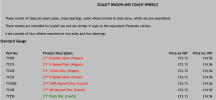
Slaters produce S7 Mansell coach wheels, 3' 7" as GWR & MR 7124GS, 7124S.
Hth
Malcolm
 

adrian

Flying Squad
but there are gaps in their S7 range for example the Mansell wheels
Which ones are missing - they seem to list some

Screenshot 2026-05-22 at 13.15.46.png
Please, is there a better way?

Peartree?


Screenshot 2026-05-22 at 13.18.13.png
 

RichardG

Western Thunderer
Slaters produce S7 Mansell coach wheels, 3' 7" as GWR & MR 7124GS, 7124S.
Yes Malcolm it helps a great deal. What I will never understand is why, when I looked for Lomac wheels and Mansell wheels on Slater's website, I could not find either in S7.

Which ones are missing - they seem to list some
Adrian I overlooked them on Slater's website.

I thought wagon wheels would be a pleasant introduction to the task before risking loco wheels but it is more difficult than I expected. It is stupid to carry on when I can buy them ready-made.
 

RichardG

Western Thunderer
DSC_2544.jpeg
Something I have discovered is, there isn't a lot for spare material on the back of a Slater's wagon wheel. I took this one down to 2.6 mm wide (should be 2.9 mm) and it came apart.

The most recent ones I turned to S7 were the European 1 metre diameter wheels and they turned easily but I have some standard wagon wheels which don’t respond to the profile tool at all well.
I am too much of a beginner to know whether I have been lucky or you have been unlucky. The brake van wheel has been in my spares box for years, the Mansell wheel was brand new from Slater's, and both turned easily once I had got a grip on them. I can have another go another day.
 

Eastsidepilot

Western Thunderer
When turning plastic centred wheels the mandrels must be putting pressure and gripping the tyre only and should not be in contact with the plastic.
I've turned F/S wagon wheels down to S7 standards with no problems, but reduce the width first by skimming the back to reduce it down to 2.9mm width. But first measure the flange width first to make sure not too much is taken off. I like to leave at least 0.7mm flange width for the profiling tool which should be 0.65mm flange width in S7.
You can skim a little off the front face if you need to get the o/a width down.
 

Overseer

Western Thunderer
No, I started with the Form 1 tool. I used this to skim the front of the tyre to make it look better, and then took about 0.5mm off the back of the tyre and the back of the plastic insert to reduce the wheel thickness to 3.0 mm, this is a bit over the spec of 2.9 mm but better too thick than too thin for a first attempt. This second operation left the flange very thin. Then I applied the profile tool to reduce the main diameter and make a new flange.
When you do driving wheels, don’t take anything off the back. It needs to stay as made to keep the back to back right. Slaters finescale flanges are quite narrow so the S7 form tool doesn’t reduce the flange width much, just the height. You can face off a fair bit from the front of the wheel without problem. Usually you don’t want to reduce the running diameter.
 

RichardG

Western Thunderer
When turning plastic centred wheels the mandrels must be putting pressure and gripping the tyre only and should not be in contact with the plastic.

Yes this should have been obvious to me but it wasn't.

DSC_2546.jpeg
I have recessed the faces of the two mandrels (and thank you Col. for the right word too!) and the result looks more promising. Hopefully no more pins.

Sorry for the awkward photo but I don't want to disturb the one in the three-jaw chuck.
 

RichardG

Western Thunderer
DSC_2550.jpeg
I've done a second wheel, this time with the tyre gripped properly between the mandrels.

I skimmed right across the back of both wheels and the wheelset will be fine for 0-MF. If I was doing this for S7 I could try leaving a boss at the centre of the plastic inserts though I expect a pair of small washers would be easier. For driving wheels there is of course a longer axle from Slater's.
 

Overseer

Western Thunderer
But if you skim across the entire back you'll still retain the btb.
True, but it introduces a potential error which is better avoided when starting out. Slaters wheels run straight as supplied, if the wheel is not held quite perpendicular in the lathe they may ‘wobble’ afterwards.
 

RichardG

Western Thunderer
True, but it introduces a potential error which is better avoided when starting out. Slaters wheels run straight as supplied, if the wheel is not held quite perpendicular in the lathe they may ‘wobble’ afterwards.

To be honest, I think we have to skim the back of the wheel because the original FS wheel is about 3.5 mm thick and we want something 2.9 mm for S7.

DSC_2552.jpeg
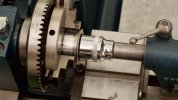
What I did was to reverse the wheel on its mandrel, and then press the assembly up against the front of the chuck before nipping up the jaws.

This isn't ideal because I really ought to have some soft jaws, but I didn't leave obvious marks on the wheels. The main thing is to make the mandrel the right length to do this.
 
Last edited:

Eastsidepilot

Western Thunderer
True, but it introduces a potential error which is better avoided when starting out. Slaters wheels run straight as supplied, if the wheel is not held quite perpendicular in the lathe they may ‘wobble’ afterwards.
If your soft jaws are machined properly to take the wheel then it shouldn't be a problem. I've all ways skimmed the backs and sometimes a little off the front of the tyres. For some reason Slaters wheels have different tyre widths between drivers and carrying wheels, why? No standards in Fudge Scale ?
 

Overseer

Western Thunderer
For some reason Slaters wheels have different tyre widths between drivers and carrying wheels, why?
Because the prototype does too. Rolling stock wheels are mostly 5 inches wide, hence 2.9 mm for S7. Steam loco driving wheels are mostly 5 1/2 inches wide and sometimes wider, so should be around 3.2 mm wide for S7, at least. Check GAs or wheel detail drawings.

The US is different as all wheels on locos and rolling stock are 5 1/2 inches wide so they can use self guarding frogs. They also have wider flanges so a bit coarser scale than UK, Europe and most other places - South Africa is another exception with wide flanges.
 

Ian@StEnochs

Western Thunderer
When I reprofile Slaters wheels I always skim the backs first with the wheel held in freshly machined soft jaws. I also take a bit off the flange diameter to make it easier on the form tool and undercut the spokes by about 0.1 at the same time. Once all wheels are so treated I mount them on the mandrel for profiling with the form tool. Last job is to hold them by the flanges, back pressed hard against the jaws, and reduce the tyre to final width and give it its chamfer on the edge. Some wheels, not all, also benefit from a skim over the boss and the countersink deepened.
 

RichardG

Western Thunderer
When I reprofile Slaters wheels I always skim the backs first with the wheel held in freshly machined soft jaws. I also take a bit off the flange diameter to make it easier on the form tool and undercut the spokes by about 0.1 at the same time. Once all wheels are so treated I mount them on the mandrel for profiling with the form tool. Last job is to hold them by the flanges, back pressed hard against the jaws, and reduce the tyre to final width and give it its chamfer on the edge. Some wheels, not all, also benefit from a skim over the boss and the countersink deepened.

Please Ian, are you writing about wagon wheels or loco wheels or both here?

There are now so many posts here about loco wheels here I feel the thread has lost its purpose, which was to find out about re-profiling wagon wheels. Unless, of course, the process is exactly the same except for the references to the countersink and the boss.
 

RichardG

Western Thunderer
Please, is there a better way? I have read a few accounts of working up loco driving wheels but nothing on wagon wheels. So I don't end up with wheels looking like Swiss cheese.

It may well be I asked the wrong question. Supposing the technique is the same as for a driving wheel or bogie wheel, then I suspect the only thing I really need to know is how much spare material there is in the front and back of the tyre. I can find this out by sacrificing a wheel or two, and learning as I go along :thumbs:
 
Top