7mm Heybridge Basin

simond

Western Thunderer
Handsome horse…. I printed a few, but I haven’t got any tack on them. The brass bits look good. I think it’ll be paper/thin card for the leather, and brass details will be added :thumbs:

I’m a little surprised by the lime wash on the cattle wagon going up to the top of the sides, I’ve only ever seen it up to “welly boot height”.

There seems to be no clear and definitive date for the end of lime wash, but some time between 1921 and 1926 seems to be favorite. That’s well after your model is based.
 

simond

Western Thunderer
It’s not super clear.

AI Overview


Limewash (or lime wash) as a disinfectant for cattle wagons in the UK was formally banned in the
mid-1920s, with most sources citing 1926 or 1927. The practice was phased out because the lime was found to be harmful to the animals' hooves, replacing it with liquid phenol-based disinfectants.
  • Timeline: While some evidence suggests the use of lime ceased around 1924, it was formally prohibited under the Animals (Transit and General) Order of 1926/1927.
  • Purpose: The white, lime-based coating was applied as a disinfectant inside wagons rather than as a paint.
  • Replacement: Following the ban, railway companies transitioned to using liquid cleaners.
RMW. https://www.rmweb.co.uk/topic/70648-cattle-wagons-and-limewashwhitewash/

It was prohibited to use limewash under the Animals (transit and General) Order of either 1924, 1926 or 1927 - regret that I can't find the originals to trace which of these it was but I suspect judging by GWR amendments that it might be 1926.
Mike.
The Stationmaster (RIP)

Though this appears fairly conclusive

Posted April 15, 2013
In the parliamentary debate of 27 Feb 1924 on the Diseases of Animals Bill, Mr Clayton asked

"...There is also the question of disinfecting railway trucks, docks, stations and markets. At present the principle in most cases is simply to whitewash, which is absolutely useless for the purpose. I would suggest that the Ministry look into the question of seriously disinfecting..."

and Major Steel asked

"...Has the Minister taken step to approach the railway companies with a view to getting them to disinfect and clean out the cattle trucks far more thoroughly than they are in the habit of doing in ordinary times?"

The speaker's responce to Major Steel was

"I have to remind the hon. and gallant Member and the House that, on the Third Reading of a Bill, the discussion is confined to the contents of the Bill, and is not of the same width as the discussion on the Second Reading of the Bill. I do not think the powers conferred by this Bill include the matters just referred to by the hon. and gallant Member, namely, the destruction of sacks and the cleaning of the railway trucks."

From which it seems reasonable to assume that limewashing was then still current. As Mike has written while I am typing, the Animals (Transit and General)(Amendment) orders or 1924, 1925 and 1926 are proving difficult to trace online, but the Transit of Animals Order 1927 24 (i) says

"The floor, roof, sides, of the inside of the truck, and the sides, ends,, and fittings of the outside of the truck, and all other parts thereof with which any animal or its droppings or other excretions, have come in contact shall be scraped and swept, and the scrapings and sweepings, and all dung, sawdust, litter and other matter shall be effectively removed therefrom; then the same parts of the truck shall be thoroughly washed or scrubbed or scoured with water; and then be disinfected by being thoroughly coated or washed with an approved disinfectant."

Nick

edit, had to nip out for a few minutes so finished that too abruptly. "Approved Disinfectant" is defined as:
"...either a five per cent. solution of standard phenol, or a disinfectant approved by the Minister for the purposes of the Diseases of Animals (Disinfection) Order of 1926, if used at the dilution at which such disinfectant is so approved."

So, it looks like the 1926 order is probably the origin of the 5% phenol solution as a replacement for limewash. Unfortunately, that order has not been digitised so is not available online


I guess between ‘26 & 27, so after Richard’s model and before mine. :thumbs:
 

RichardG

Western Thunderer
From the LNWR Society at Handling the Goods | The London & North Western Railway Society:

DNR0960.jpg
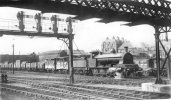
Typical mixed goods train passing Crewe. The first two vehicles are cattle wagons covered in limewash used as a disinfectant. A practice banned in the mid 1920’s as harmful to the animals.

The limewash has been carried right up the sides here.

I do like the LTSR cattle wagon, scratch or kit built?
My model is from the Three Aitch kit. I have an unbuilt kit to hand, and it looks as though Douglas built it straight from the kit without alterations.
 

RichardG

Western Thunderer
DSC_2302.jpeg
When I started this project, I didn't have a clue how I was going to represent the through traffic from the GER, but I thought it would be doable somehow or other. Now I have seven of their wagons, these five and two more unpainted. Three of the total were built by myself, four by others.

The H2 has brought these wagons from the exchange siding at Langford.

I will take these to Albury so they can add a bit of extra local content; I'm sure they can sit as stage props in a siding near the back!
 

RichardG

Western Thunderer
DSC_2864.jpeg
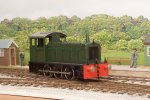
This wee beastie arrived today from Ellis Clark. A Sancheng Brass model by Bachmann. The wheels are unmarked, as though it has never run. In fact, the entire loco is spotless. A curiosity is the daylight visible through the radiator grill and out through the side louvres, as if there is no engine inside. Which indeed there isn't.

DSC_2866.jpeg
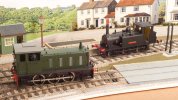
Despite my efforts to build a late 19th century scene, this loco seems very happy here. Perhaps Heybridge Basin is really a Martini layout :rolleyes:

This loco is for a possible future project.
 
Programming track New

RichardG

Western Thunderer
DSC_6474 (1).jpeg

Quite a lot of effort to extend a headshunt by 150 mm!

Until last week, Heybridge Basin was an analogue layout, wired with all tracks live all the time. I could run one track-powered loco, plus one or more of my battery-powered ones.

I am converting my analogue locos to DCC. Heybridge Basin doesn't really need any wiring changes (just connect a different controller) but experience has taught me a programming track is a highly desirable thing. I write this as someone who once did a factory reset on a decoder, and reset half a dozen other locos at the same time. Because I had forgotten they were still on the layout :oops:

DSC_3026.jpeg
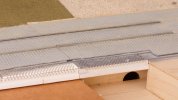
I looked at the layout this morning and my programming track looked back at me. This short extension of the headshunt is long enough to take any loco I will want to run on the layout. I don't need to go cutting into rails.

DSC_3019.jpeg
The circuit board is a software-controlled switch from NCE. They sell it for use with their PowerCab but it works with other DCC systems. When the controller enters its program mode, the board responds and operates a relay. For me, this disconnects all of the layout downstream from here. Any locos on the layout or in the fiddle yard are isolated, and only the short length of headshunt remains live.

This board is NCE part number 5240226. I salvaged this one from my mothballed H0 layout. A toggle switch will do the same thing, but I cannot forget to operate an automatic relay :rolleyes:
 

simond

Western Thunderer
Excellent info, thanks Richard.

I have a switch that operates a relay to connect the front track to the programming outputs, and it’s interlocked with the crossover, so “oops” cannot occur…. So far so good.

the NCE thing would be better, though I’d want to incorporate the interlock. I shall investigate.
 

Yorkshire Dave

Western Thunderer
I've mounted all my programming and testing equipment on a separate board so I can do this away from the layout. I built up a rotary switch to select the decoder programmer or command station input with either a decoder tester or programming track output. The selector box has a locking 2 pin connector for power supply and a pair of 4mm banana plug sockets for which I have made up a pair of leads - 4mm to 4mm - to connect to the programming track. The command station was from a Roco trainset.

DCC.jpg
 

RichardG

Western Thunderer
There always seems to be a paradox in the way I want the layout to be looking neat and tidy, and still be able use it in ways haven’t yet thought of.

I have not found out how well the NCE auto switch will enjoy being fed analogue DC. On the last layout, the programming track was a length of the main line; and so I wired in a four-pole changeover switch to connect this to the tracks at both ends and bypass the auto switch for analogue operation. It was simplicity to use, but the wiring was verging on being silly.

For analogue operation at Heybridge Basin, I can set the DCC controller to its programming mode (to disconnect the last length of the headshunt), attach an analogue controller in the fiddle yard, and away I go. Perhaps install a temporary buffer stop to stop wheels bridging the gap at the programming track.
 
Last edited:

RichardG

Western Thunderer
I shall investigate.

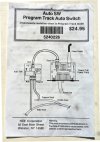
Here is the instruction leaflet. The weakest part of the design is the rather small terminal blocks. They will take 16/0.2 no bother, but the 6 amp mains cable I use (to minimise voltage drop) had to be stripped, lightly tinned and then forced in with pliers. For a large layout I guess you would use the relay to operate a bigger relay :)

2026-07-07 11.13.01.jpg2026-07-07 11.13.08.jpg
 

simond

Western Thunderer
Thanks Richard,

I suspect it is specific to NCE, and will not work with the Lenz system I have. No worries, thanks for posting the docs.

The Lenz booster has two terminals for the main DCC output and two for the Program Track. I connected them to the fixed terminals of a relay, the moving terminals go to the front track of the locoshed layout. The relay is switched (via a bus and all sorts of unnecessary but entertaining complexity) from the instrument panel but incorporates the spare terminals of the Tortoise on that crossover so it will only change to programming if there is no way of a loco getting on or off the programming track.

I guess if I wanted to mess up the system (and probably break my Lenz booster), I could arrange a loco on the short length of track within the crossover and then get it to trail the point, but I think it would be impossible to do it by mistake.

I have found the GF rod, they are 500mm long. I will cut one to fit the envelope and hopefully post tomorrow. It'll do a couple of locos...

cheers
Simon
 

RichardG

Western Thunderer
I suspect it is specific to NCE, and will not work with the Lenz system I have.

Not entirely - it certainly works with my 'Roco z21 Start'.

I started in DCC with an NCE PowerCab because this was what people recommended to me. I thought the controller was more like an item of test equipment than a model train controller, and after a while I moved to the Roco system. This is, to me, much more user-friendly. I kept the auto switch when I sold the PowerCab.
 

simond

Western Thunderer
Thanks, that’s interesting. Roco & Lenz are compatible. I’m not a fan of NCE controllers.

I habitually use a red Multimaus on my setup as it’s nicer to use than the Lenz controllers, though the LH can do more stuff.

I wonder how it knows…
 
Top