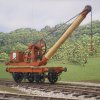
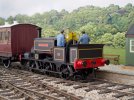
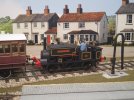
7mm Heybridge Basin

RichardG

Western Thunderer
Dave, I think this rendering is amazing. It is as though my "Heybridge Railway" project has progressed from being merely plausible to believable to convincing in the space of a week or two. I can now imagine finding (inventing) some contemporaneous correspondence from the Board of Trade to the railway, telling them about the need for proper fences. The handwritten caption looks utterly convincing too! Thank you very much.
 

RichardG

Western Thunderer
Self-adhesive glass / window coverings are available in a range of transparency - translucency - limpidity - whatever the right word is.
You may find one that changes the colour tone of the backscene and at the same time make it more appear more distant.
Even a matt film might transform it.

The buildings are printed onto photo paper which has a slight sheen, while the paper backscene is dead matt. So while the colours and intensities match up pretty well, the buildings catch a tiny bit more light and they do look as though they are nearer. The sky is pretty good too, so I'd like to keep the buildings, foreground and sky as they are.

I think a window film would need to be cut to fit the outline of the more distant row of trees. I have found film which stays put with static electricity not glue. I am a bit reluctant to buy a whole roll for something experimental . . . maybe I will find an offcut one day to have a play with. Thanks for the idea :thumbs:
 

RichardG

Western Thunderer
I do think there’s a lot to be said for “top deck of the bus” (rather than low-flying aircraft) viewpoints

Yes, and what's more I think a slightly elevated view (c. 77 mm / 11 scale feet above the ground) makes for a nicely enjoyable photo if perhaps a little toy-like.

2026-02-13 09.46.43.jpeg
This is from the phone camera, with lighting from the lighting rig and an LED panel.

I get the subject of "weathering" suggested from time to time, and I am starting to comprehend what a sensible treatment might look like.
 

Yorkshire Dave

Western Thunderer
I can get away with a wider range of viewing angles.

For photography the angle can be quite critical.

I've noticed between these two photos the first one with a more acute angle has distorted the perspective on the buildings making them appear narrower.

2026-02-12 07.16.49.jpeg

Whereas this one, albeit from a higher viewpoint, taken from a shallower angle retains the perspective in relation to the buildings.

2026-02-13 09.46.43.jpeg
 

RichardG

Western Thunderer
Whereas this one, albeit from a higher viewpoint, taken from a shallower angle retains the perspective in relation to the buildings.

View attachment 257529

This is where the train is posed for the better (the second) of those two photos:

2026-02-13 16.05.20.jpeg
Here, the plane of the camera sensor is close to being parallel with the buildings from left to right (though they are on a curved backdrop), but leaning forwards slightly from a raised viewing position. And so the corners of the buildings are pointing towards a vanishing point some distance below my feet.

2026-02-13 16.08.12.jpeg
Moving the viewpoint to the left, distortion in the backscene begins to show more.

2026-02-13 16.29.01.jpeg
And then, moving the viewpoint downwards straightens things up.

So I have some latitude from left to right for composing photos near here. It is fortunate the human eye is much more tolerant than the camera when looking at the buildings.
 
. . using a pinhole 'lens'

RichardG

Western Thunderer
2026-02-14 20.23.53.jpeg
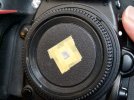
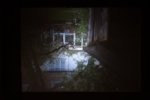
I have had a go with a pinhole lens on the DSLR. This is a spare body cap, drilled through 4mm diameter and with a piece of kitchen foil providing the pinhole. The foil is darkened on the inside using a black Sharpie.

DSC_1913.jpeg
I had three goes at making pinholes. This is the best result using the best pinhole so I will call it a day here with pinhole lenses for model photography.

I do like the results achieved by @Yorkshire Dave and hopefully one or two of his images can make it onto a display board in front of the fiddle yard. Thanks Dave :thumbs:
 

simond

Western Thunderer
There is a camera obscura in one of the museums (the British, I think) in London, and it is pin sharp.

Do you think that your image would be sharper (though smaller) if you moved back from the subject? I presume your camera has lots of fancy electronics and may normally “do stuff” to the image by physical manipulation of the lens, which it cannot do if the lens isn’t there?
 

RichardG

Western Thunderer
There is a camera obscura in Edinburgh, also pin sharp but it uses a glass lens. The place is full of large-scale optical illusions like rooms which look perfectly normal but where the floor and ceiling converge and only a child can stand up. Good fun really.
 

magmouse

Western Thunderer
Do you think that your image would be sharper (though smaller) if you moved back from the subject?

I’m pretty sure it would make no difference - the pinhole creates an equal amount of out-of-focus blur irrespective of the distance to the subject. If you look at Richard’s photo, you’ll see that the blur is the same from the foreground to the background. It works quite differently to the way a lens focuses the subject.

Possibly the camera obscura you’ve seen used a lens - some do. Some of my students once made a room-sized camera obscura by blacking out the window, all apart from a piece of wood with a hole about an inch or so across. The image on the opposite wall was very dim, but if you stayed in the room until your eyes adjusted to the light level, the effect was quite magical.

Nick
 

simond

Western Thunderer
Thanks Nick, predictably, your post sent me googling and predictably, Wikipedia provided some answers.


to my surprise, it appears that something of the order of 0.2mm would be appropriate. It would be relatively easy to 3DP an extension tube to vary the hole-to-sensor distance. I guess printing a dome of suitable diameter would allow the pinhole diameter to be “adjusted by file” and that would also give a very thin pinhole plane.

but I’ve got a loco to build…
 

magmouse

Western Thunderer
Yes, you can make a zoom pinhole camera that way. I've done it with a set of bellows between the pinhole and a digital camera.

This is a picture of the back of my house, taken from the end of the garden, and made with a camera obscura constructed from a cardboard box about 400mm cubed, with a circa 4mm hole on one side and tracing paper the other. The image on the tracing paper was then photographed with a normal camera.

XT2S7868.jpg

I should let Richard get back to his normal programming now...

Nick.
 

RichardG

Western Thunderer
2-56270.jpg
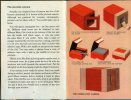
I have dug out my copy of the Ladybird Book "How it Works, The Camera". I read this through so many times when I was around 10-12 years old and it is still useful.

It looks to me as though a good distance from pinhole to sensor might be 1.5 times the diagonal of the sensor. Maybe such a distance would produce a sharper image? I can buy a set of extension tubes very cheaply on eBay, and it seems hardly worth the effort to draw and print some . . . but I do recall I got rid of the set I had because I never found them very useful. A proper macro lens is a lot easier to use.
 

magmouse

Western Thunderer
Maybe such a distance would produce a sharper image?

I don't think so - I would expect it to get worse. Light comes from a point on the subject, and passes through the pinhole on a very slightly diverging path (think about a light ray that passes by one edge of the hole, and another ray that passes through by the opposite edge - they are very slightly diverging). So moving the sensor away from the hole means the area where light from a point falls is now bigger - though probably by so little, there's not much apparent difference. To get a sharper image, you need a small hole relative to the sensor size - which is why my camera obscura in a cardboard box with it's 4mm or so hole gives similar sharpness to your pinhole on your camera. Similarly, a room size camera can have a 1-2 inch hole and give a quite sharp image.

Two further thoughts - for really small pin holes, diffraction effects probably are the limiting factor with sharpness - just as diffraction comes to limit the sharpness achieved by lenses when stopped down to around f/16 or smaller.

Secondly, I wrote earlier:

I’m pretty sure it would make no difference - the pinhole creates an equal amount of out-of-focus blur irrespective of the distance to the subject.

I now think I'm strong about this - a close subject means the pin hole is bigger, relative to the subject distance, and the light rays therefore are diverging more. However, and again - I suspect the effect is negligible unless the subject is really close, and diffraction probably dominates with small pinholes.

Now, does anyone have anything to say about model railways? :)

Nick.
 
. . removing shadows from display case

RichardG

Western Thunderer
Now, does anyone have anything to say about model railways? :)

I'm not ready yet!

2026-02-15 12.27.51.jpeg
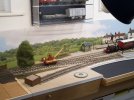
The lighting rig casts multiple shadows from this display case onto the backscene. Up until now I have been removing these shadows by dismantling the bottom shelf of the display case. Which is a bit laborious.

An easier method is to throw more light onto the model, in this case from a fluorescent studio lamp. I found this and its reflector in a charity shop. The lamp specification is 135W, triphosphor, 5,500K and Ra>92. Looking at similar ones on Amazon it probably produces the equivalent of around a 650W light bulb. Which is quite a lot of light on a model barely half a metre away.

2026-02-15 12.19.07.jpeg
The result is, the phone camera lowers its simulated ISO rating to obtain a correct exposure.

I am particularly happy with the rendering of the wheels, the sharpness from end to end, and the join in the backscene. The rails in the foreground are softer than I would really like but hey, if the phone camera can do this I should be satisfied. Any shadow on the backscene from the studio lamp has been washed away by the lighting rig.

I have enjoyed all of the contributions here from everyone since I started to post photos with the new backscene.
 
. . softer lighting

RichardG

Western Thunderer
2026-02-15 18.25.18.jpeg
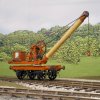
Finally, the fluorescent studio lamp with a translucent brolly. I have never used this brolly before, it seems quite huge indoors.

2026-02-15 18.27.29.jpeg
Nicely soft, so much so the join in the backscene has all but disappeared. I do like this look for the crane, though whether lighting for a fashion model will be quite right for every model train I'm not sure.

I removed the telegraph office for my last two layout photos. The scene is so anonymous I am sure it can double as a photo plank, so that's one less thing to build and find somewhere to store.
 

RichardG

Western Thunderer
2026-02-16 09.44.32.jpeg
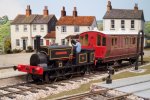
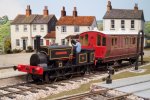
Staying with the fluorescent photo lamp and the translucent brolly (and the lighting rig) for two more photos. The phone camera isn't giving me quite as much DoF as I would really like, witness the coach lamps. But somehow, this doesn't detract. The Minerva paint is wearing away from handling of the loco. The two figures were painted by Dan Evason, the owner of Tunnel Lane Models.

2026-02-16 05.59.54.jpeg
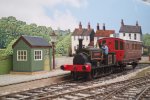
A higher viewpoint to show how the colours work together. I like having the soft look all the way through here. The backscene should help me to choose the colours for the cobblestones, these have been in primer for a very long time.

I feel, I have the light under control. There is enough shadow to give depth to the scenes but no shadows falling in unwanted places like onto the backscene.

Time to pack the brolly away and return to the workbench :)
 

RichardG

Western Thunderer
Time to pack the brolly away and return to the workbench :)

Except, I am not quite ready.

Here are some more photos, trying out different locations and viewpoints. The backscene is going to appear in just about every photo on the layout, so I'm glad I'm pleased with it!
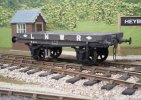
2026-02-19 19.23.52.jpeg
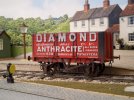
A LNWR wagon built by Douglas Thomas, GOG 1818.
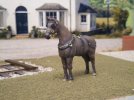
2026-02-19 16.46.40.jpeg
A horse from Duncan Models, painted by Dan Evason.
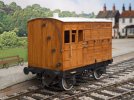
2026-02-19 16.01.23.jpeg
LT&SR horse box, in its condition as rebuilt in 1888.
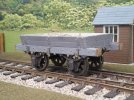
2026-02-19 16.55.09.jpeg
Unbraked GER-pattern ballast wagon, from Ragstone Models. The GER painted theirs red.
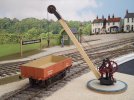
2026-02-19 19.26.24.jpeg
GWR 4-plank wagon, from the Slaters/Coopercraft kit.
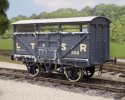
2026-02-19 19.22.05.jpeg
LT&SR horse box, by Douglas Thomas.

2026-02-16 10.12.38.jpeg
Dapol RCH wagon, factory weathered.

Photos of short trains ought to be possible one day, but the viewpoints will invariably include the basin in the frame and I haven't built this yet. All of the these are using the camera in the Google Pixel 6a. On painted models, it is bringing better results for me than my DSLR.

 

RichardG

Western Thunderer
Do you think that your image would be sharper (though smaller) if you moved back from the subject? I presume your camera has lots of fancy electronics and may normally “do stuff” to the image by physical manipulation of the lens, which it cannot do if the lens isn’t there?

My camcorder definitely uses software to compensate for deficiencies in the lens. This is how Canon manage to create a 20x optical zoom which works so well. I suspect my modile phone camera does similar tricks, because the image linearity is remarkably good for a lens which surely cost only pennies. But for the DSLR (Nikon D7200), I don't think there is anything in the lenses nor the camera body to correct for optical deficiencies. Both of my portrait lenses (50 and 85 mm) have a vibration reduction feature and this certainly works. But the camera is very reliant on the glass attached in front of it. The 85 always produces better colour than the 50, and this is surely down to the glass. The 85 bought secondhand cost me as much as a loco kit, but it always a joy to use.
 
Last edited:
Top