Richard's American Train Adventures

mickoo

Western Thunderer
Curious to know why the consist was rated a double header? I wouldn't have imaged that ten vehicles would be a struggle for a single Siemen's Charger....

Wonder whether the second loco had failed - alas I can't work out whether both were under power.

Cheers,

Stephen
Amtraks are frequently double headed, it's a motive power insurance policy I believe. Also, from observations in the PNW and Cajon, five coaches seems to be the limit for solo units. The Budds are quite light weigh but the double deckers are not and combined they require a fair degree of hotel power; I don't think the Charger or Genesis had dedicated HEP power packs so it'll all be sapping off the main generator.

In addition some trains split or join so it may be picking up extra coaches further en route, or has dropped some off; those portions would have their own power and not part of the main train.
 

Stephen

Western Thunderer
Amtraks are frequently double headed, it's a motive power insurance policy I believe. Also, from observations in the PNW and Cajon, five coaches seems to be the limit for solo units. The Budds are quite light weigh but the double deckers are not and combined they require a fair degree of hotel power; I don't think the Charger or Genesis had dedicated HEP power packs so it'll all be sapping off the main generator.

In addition some trains split or join so it may be picking up extra coaches further en route, or has dropped some off; those portions would have their own power and not part of the main train.

Cheers for the info Mick - make perfect sense about the insurance policy, I doubt they have a pool of locos lying around at strategic places in the case of failure....and if they did lord knows how long it would take to perform the 'rescue'. I presume other freight hauliers would be reluctant to get involved in the event of a failure as well?

Cheers,

Stephen
 
Last edited:

mickoo

Western Thunderer
Cheers for the info Mick - make perfect sense about the insurance policy, I doubt they have a pool of locos lying around at strategic places in the case of failure....and if they did lord knows how long it would take to perform the 'rescue'. I presume other freight hauliers would be reluctant to get involved in the event of a failure as well.

Cheers,

Stephen
Not so, the vast majority of US lines are single track, scarily vast amounts, on the North side of the gorge BNSF principle line is single track with long passing loops, primarily down to geology. The same applies to Stevens and Marias passes which have a lot of single line running, consequently when Amtrak fails (and it happens often enough) then the owning Railroad are swift to despatch a rescue loco to tack on and remove the blockage.

The growing problem appears to be finding units that can assist from the head end, BNSF run almost two fleets, those that have cab signaling and comms for head end running and those which are secondary units and must not be manned. Frequently these are in the head end consist but often they can be DPU's and it might be a bit of a task finding a lead unit that can be cut out to assist.

I think both UP and BNSF now ban thunder cab ACe's from leading and it's getting rarer to see Dash 9's (Cigar Band fake bonnet) on the point these days.

This is a banned manned unit mid consist, note lack of number boards, it's also a storage pool unit that is dropped in and out of service as demand varies (late summer and autumn are good times to grab these as the grain season is in full flow), note square structure around stack which holds two flip up lids fore and aft to pop over the stack when in storage. It still has the Comms pack on the roof though some of that might be engine data transmission as opposed to signaling and voice comms, A small note on the door said DPU ONLY - NO CREW.

IMG_4171.jpg
 

Yorkshire Dave

Western Thunderer
Cheers for the info Mick - make perfect sense about the insurance policy, I doubt they have a pool of locos lying around at strategic places in the case of failure....and if they did lord knows how long it would take to perform the 'rescue'. I presume other freight hauliers would be reluctant to get involved in the event of a failure as well?

Also, they don't have the number of passenger or mixed traffic locos as seen in Europe to call upon in the event of failure. Added to which the density of European railways means loco depots are closer together providing a vast pool to call upon if necessary and most, if not, all international and domestic express passenger routes are electrified so 'hotel' power does not become an issue. Granted, a fair number of these expresses are in the hands of EMUs but loco hauled international and domestic expresses still exist.

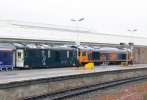
The nearest equivalent we had in the UK was the Caledonian Sleeper being class 66 hauled with a class 73/9 providing the 'hotel' power. Although the 73/9 s were re-engined they don't quite have enough power on a long train to maintain the schedule from Aberdeen, Inverness and Fort William to Edinburgh hence the class 66 in addition. Since my photo in 2016 the situation may be different today with the newer rolling stock.

My photo, Inverness, June 2016.

Inverness 01.jpg
 

richard carr

Western Thunderer
Here's the next video from Greenwich OH, about an hour from Elyria.

In less than hour we saw 5 train pass through, I missed the first one as it arrived literally as we did, but the other 4 are here.
The stat of the show is the Wheeling SD40-T2, they had to wait until all the CSX traffic had passed through the junction first.


mickoo

Western Thunderer
And now the final video for 2025.

This was the friday morning action in Goshen IN.
Too much waiting around for trains, but in the end I saw 3 and the 2 bay hoppers pulling away sounded great.

That high pitched squeal is super slip/grip/traction in action, watch the axle hubs (more so) on the last truck and you can see them slipping and snatching as the load varies. Super slip commands the wheels to turn at 7% more than the actual rail speed, adhesion is at maximum with 7% wheel slip, any higher and it breaks away to near zero grip, hence the juddering/snatching as the wheels slip and grip. Perfect adhesion is when the wheels spin smoothly slightly faster than actual speed, fun to watch in Cajon, but here the (variable) damp rail is having an adverse effect.

On BNSF C4 locos the middle axle will raise (partially) as well to add more weight to the outer axles, I think the load controller limits that feature to speeds below 21 mph or something, above that your looking more for grunt than grip and the middle axle automatically lowers to spread the weight; the middle axle on C4 locos is not powered, only the outer two.

Damn I miss GEVO's pullin hard....
 

Scale7JB

Western Thunderer
That high pitched squeal is super slip/grip/traction in action, watch the axle hubs (more so) on the last truck and you can see them slipping and snatching as the load varies. Super slip commands the wheels to turn at 7% more than the actual rail speed, adhesion is at maximum with 7% wheel slip, any higher and it breaks away to near zero grip, hence the juddering/snatching as the wheels slip and grip. Perfect adhesion is when the wheels spin smoothly slightly faster than actual speed, fun to watch in Cajon, but here the (variable) damp rail is having an adverse effect.

On BNSF C4 locos the middle axle will raise (partially) as well to add more weight to the outer axles, I think the load controller limits that feature to speeds below 21 mph or something, above that your looking more for grunt than grip and the middle axle automatically lowers to spread the weight; the middle axle on C4 locos is not powered, only the outer two.

Damn I miss GEVO's pullin hard....
That’s some serious knowledge.. oh and I think you just doubled Richard’s number of views on that film :))

JB.
 

richard carr

Western Thunderer
I'm going to watch it again, and when I get home and have some decent sound with it. It's had 58 views already so not just folk on here.
 

mickoo

Western Thunderer
That’s some serious knowledge.. oh and I think you just doubled Richard’s number of views on that film :))

JB.
It’s a very large and flappy anorak, more trench coat. Most of the info is available and I just read a lot. Trains magazine (I think) used to do yearly diesel specific mags with all the new stuff in and technologies.

All engines have some sort of slip control way back but the dash 2 featured some of the first electronic versions I think. AC units work best as you have much finer control with modulation control ( my job on the docks) and each motor has its own inverter pack though I believe early AC units may have had one inverter for two motors or other combos.

Super slip squeal is different to flange squeal which modulates and fades in and out, super slip is a near constant squeal and I find it actually quite painful up close, on dry rail you’ll often see blue smoke or haze around the wheel/rail interface. For total anorakness the speed radar is behind the front pilot below the coupler and points back and down toward the track.

Older locos relied on encoders attached to the axle to feed back actual speed but modern electronics look at track speed and set motor speed and then watch current as feedback, if it slips then current drops off and the electronics reduce power until it stabilizes and ramps it back up, all in a blink of an eye.
 

mickoo

Western Thunderer
Not to detract further but this is a really good video of slip control on modern locos in action, the middle axle tends to be the one that slips the most due to weight (un)loading under high adhesion, you can see it juddering as it bites for grip and the electronics loading and unloading looking for ideal grip; the rear axle is also doing it a bit as well but this axle takes the most adhesion/load (weight/adhesion transfer, another rabbit hole we'll leave well alone) when starting. The leading axle (least loaded) is doing just fine, when he zooms in (around 1 min - 1:45) you can just see it slipping smoothly at a slightly faster rate than rail head movement.

I'd have to find the info again but I think the fact that the middle and partially the rear are slipping is telling the electronics to hold back out of super slip, there's no point applying more power if any of the axles are slipping greater than 7%, once you're moving then it can ramp it up. I'm sure slip control gets you moving, super slip is for acceleration once moving and grip has stabilized but I can't remember where/if that threshold changes, that's not to say an axle won't break away and judder under super slip but generally things are smoother.

There's no high pitched squeal here so I'm thinking it's still in slip control and hasn't fully engaged super slip.

 
Last edited:

mickoo

Western Thunderer
I'm going to watch it again, and when I get home and have some decent sound with it. It's had 58 views already so not just folk on here.
It's a good get away video, he's applied power to get moving, held back until he's passed the crossing and the full train is moving at a stable speed and then ramped it up. I've watched it full screen now and it's hard to see the axles slipping but I think it's there, though the high pitched squeal is a better way to know when super slip is active.
 

Stephen

Western Thunderer
Not to detract further but this is a really good video of slip control on modern locos in action, the middle axle tends to be the one that slips the most due to weight (un)loading under high adhesion, you can see it juddering as it bites for grip and the electronics loading and unloading looking for ideal grip; the rear axle is also doing it a bit as well but this axle takes the most adhesion/load (weight/adhesion transfer, another rabbit hole we'll leave well alone) when starting. The leading axle (least loaded) is doing just fine, when he zooms in (around 1 min - 1:45) you can just see it slipping smoothly at a slightly faster rate than rail head movement.

I'd have to find the info again but I think the fact that the middle and partially the rear are slipping is telling the electronics to hold back out of super slip, there's no point applying more power if any of the axles are slipping greater than 7%, once you're moving then it can ramp it up. I'm sure slip control gets you moving, super slip is for acceleration once moving and grip has stabilized but I can't remember where/if that threshold changes, that's not to say an axle won't break away and judder under super slip but generally things are smoother.

There's no high pitched squeal here so I'm thinking it's still in slip control and hasn't fully engaged super slip.


Within the UK rail industry its always been referred to as 'creep control', I think the term 'super slip' would give the wrong idea that the wheels are slipping uncrontrolled. Looks like it is an EMD creation, which an IET paper quite eloquently describes as:

The nub of creep control is that a locomotive accelerating from rest can develop from 33 to 50% more tractive force if its powered wheels are allowed to creep into a slight, steady slip.

The Class 60's were given a similar system and by all accounts it was actually superior in some applications. Talking to a driver at Warrington Bank Quay he and his colleagues stance was that the 60's ability to haul the National Power trains out of the power station on that incline and curve was better handled by the 60s, than the 66s due to the superior creep control.

Cheers,
Stephen
 
Last edited:

oldravendale

Western Thunderer
In ignorance, and knowing nothing of NA railways... I'm familiar with cadence traction control and braking. However, as you've described this, Mick, with wheels apparently designed to skid on the rail head to a greater or lesser extent there must be considerable wear to the tyres and rail head. I know from chats with the PW chaps on the GC that they get very upset when they see driving wheels skidding as trains leave stations - an entirely different concept I realise. It may be, of course, that the replacement costs of wheels and rails are offset by the economies of power/speed/acceleration but you have successfully created a curiosity bubble here at Dale Towers.
 

mickoo

Western Thunderer
Within the UK rail industry its always been referred to as 'creep control', I think the term 'super slip' would give the wrong idea that the wheels are slipping uncrontrolled. Looks like it is an EMD creation, which an IET paper quite eloquently describes as:

The nub of creep control is that a locomotive accelerating from rest can develop from 33 to 50% more tractive force if its powered wheels are allowed to creep into a slight, steady slip.

The Class 60's were given a similar system and by all accounts it was actually superior in some applications. Talking to a driver at Warrington Bank Quay he and his colleagues stance was that the 60's ability to haul the National Power trains out of the power station on that incline and curve was better handled by the 60s, than the 66s due to the superior creep control.

Cheers,
Stephen
You are of course correct, the term super slip/grip/traction et al is one of probably dozens used to describe the mechanical effect, it depends where your reading and who wrote it, different companies have different names as do guys on the ground and railfans; also taking into consideration UK/US nuances in language/terminology as well.

The class 60 and 66 are DC machines so effectively both hands and one leg tied behind their back, the electronics are good but it's hampered by the motor on the axle, DC motor wheel spin is (generally) very crude though it does depend on how they split the motor feed, either to each motor or grouped, in a class 47 it's all going in one lump to all the motors so one can spin away merrily whilst the others try to grip. The same would apply to AC motors but because they're more modern then tend by default to have individual motor control.

I think the EMD Dash 2 series was the embryonic of slip control but I don't think the extra slip advantage was used until much later, probably down to DC motor usage, it only really seems to crop up on a more consistent basis once AC traction took hold, certainly in the US.

I'm sure Taurus and TRAXX (Eurosprinter) loco's have been using it for many years (en masse) before the US in Europe, having said that both of those locomotives are so powerful and so well tuned in traction control and weight distribution mechanics that they probably don't need to employ slip control.
 

mickoo

Western Thunderer
Yes that's a great video, you can see why the front axle doesn't slip, it's all that sand, it really does make a difference.
Sand makes a huge difference and the remainder left after the first axle is helping the third, the middle one is always lightest loaded by mechanics and slips the most, hence BNSF sitting back and going 'it's doing sod all traction wise so might as well take that motor away', thus the C4 is developed for exactly that reason, at low speeds and heavy loads the middle axle is near useless, take the motor away and save costs on maintenance, then make the wheel lift able so more weight is on the front and back and suddenly you have the same adhesion factor as an engine with six motors.

The adhesion factor is mute and depends on who is talking, drivers dislike it, maintenance and accounts love it, on paper there's very little difference in performance from a C4 to stock truck.

One other thing with sand, even after the passage of the locos there is a residual on the rail head, it's been found that this then creates additional drag on the train and thus load, especially on curves. Some engines employ a railhead cleaner, originally it was a seperate air supply/nozzle on the outer ends of the trucks cleaning the rail head, now I think they use the same pipe but just shut off the sand and apply very high air pressure down the same pipe.

You'll see this is if you look closely (very) at the last sanding pipe on the trailing truck, it looks like it's laying sand but in fact it's blowing residual sand off the rail head. I don't think all engines have this as the jury is out on its benefits, cost and maintenance over efficiency etc. I've seen it in Cajon but can't remember which units had it, where speed is low and drag/traction are their highest, plus you can get nice and close 'safely'.

I'm sure some UP ACe's had it fitted, those mostly pooled for coal service, maybe BNSF too and some GEVO's may have had it fitted. It's kind of mute in general pool service as for it to work effectively you need all unit to have it, no good have three up front with it if the fourth (trailing) unit doesn't.
 

mickoo

Western Thunderer
In ignorance, and knowing nothing of NA railways... I'm familiar with cadence traction control and braking. However, as you've described this, Mick, with wheels apparently designed to skid on the rail head to a greater or lesser extent there must be considerable wear to the tyres and rail head. I know from chats with the PW chaps on the GC that they get very upset when they see driving wheels skidding as trains leave stations - an entirely different concept I realise. It may be, of course, that the replacement costs of wheels and rails are offset by the economies of power/speed/acceleration but you have successfully created a curiosity bubble here at Dale Towers.
Yes there will be wear, but if you have seven units per train and can dispense with one or even two to haul the same load then the cost savings are worth it, those units can then be deployed on other revenue services earning money, also on the big spreadsheet in the head honchos office you can reduce your overall number of locos.

I can't find an exact cost for a GEVO today but they were $3m ish in 2010 so lets say $5m today, you can do a lot of wheel turning and rail grinding if super slip saves say 100 (conservative....very) less locos on the books.

Slipping is different to skidding, slipping is a smooth linear wear over a given distance, skidding is a localised point wear and creates flat spots on the wheel rim, flat spots are bad and only get worse, they can in extreme cases cause rims to split and collapse, they also impact a shock to the rail and truck with every revolution and when the train brakes next time the wheel will momentarily stop at the same spot and make the flat spot even bigger.

Slipping on the GCR is almost certainly a steam engine, slipping on steam engines is almost totally out of control, the risk there is not damage to the track or wheel, but to the motion and often catastrophically. Having said that, slipping at a stand still will wear a flat spot on the rail (the inverse there of) and damage the rail head, there's been some monumental slipping on SAR iron ore roads I've seen where a drunk driver has let the engine slip for hours and almost ground all the way through the rail.

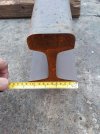
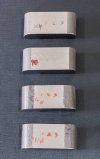
One other aspect, only the rail head is strengthened/hardened during manufacture, the rest of the rail is just normal steel, once you get through that hard skin on top you'll chew down through the rail real quick. Our cranes I went to in China had the same (trolley) rail as Australian light railways (P75 profile if I recall correctly) We had to cut test sections out and then pin point hardness check different areas. The running surface was much harder than the web and foot (however the rail also had to be harder than the wheel, the wheel is the sacrificial part of the mechanics, as it is on locomotives) thus we had to non destructive test all the wheel rim hardness as well.

And yes, we had skidding and slipping on the cranes all the time and it made a right mess of the rails and wheel rims, again DC motors where hard to control, AC much better at accelerating and stopping loads.

Tests across rail head to make sure it was uniform and dept to make sure hardness extended down to our minimum wear threshold.
20180705_101156.jpg

IMG_8083.jpg

IMG_8090.jpg

Sorry Richard, I'll let you have your thread back :cool:
 
Last edited:
Top