
You are using an out of date browser. It may not display this or other websites correctly.
You should upgrade or use an alternative browser.
You should upgrade or use an alternative browser.
7mm Mickoo's Commercial Workbench
- Thread starter mickoo
- Start date

mickoo
Western Thunderer
I think it’ll be incorrect as 6200 had a unique chimney at this stage, a one off I believe.We do a nice brass chimney for these - Mike Hopkins' design.
Dave
She kept it all her life, which I find intriguing as smoke boxes and boilers were often intermixed during shop visits and, at some point there must have been a combustion chamber firebox and boiler fitted.
I need to cross reference all that eventually, but for this model in as built guise it will have the individual type fitted.
mickoo
Western Thunderer
Another one across the bench, a quick 10 day fill in build and this is day 5 progress.
Finney7 94xx, does what it sez on the tin, it rewards the careful and diligent, punishes those who aren't.
My chassis was sitting too low by 0.5 mm, no idea how or why as I can't see anything obviously wrong (in the kit design or what I've done), consequently my OF rims were touching the splasher tops. I packed the compensated bearings out with a 0.4 mm shim and the front pivot arm with a brass tube sleeve of similar dimensions and all was right with the world.
I also found the splasher tops a fraction too short (0.5 mm or so) and checking a few other aspects I think that sheet has been over etched a touch; it's not a problem to cut new ones from sheet brass.
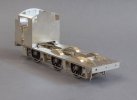
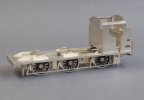
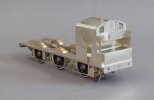


Finney7 94xx, does what it sez on the tin, it rewards the careful and diligent, punishes those who aren't.
My chassis was sitting too low by 0.5 mm, no idea how or why as I can't see anything obviously wrong (in the kit design or what I've done), consequently my OF rims were touching the splasher tops. I packed the compensated bearings out with a 0.4 mm shim and the front pivot arm with a brass tube sleeve of similar dimensions and all was right with the world.
I also found the splasher tops a fraction too short (0.5 mm or so) and checking a few other aspects I think that sheet has been over etched a touch; it's not a problem to cut new ones from sheet brass.

SimonT
Western Thunderer
Blowed if I know why either. The CAD features a set of Slater's wheels that have adequate clearance.My chassis was sitting too low by 0.5 mm, no idea how or why as I can't see anything obviously wrong (in the kit design or what I've done), consequently my OF rims were touching the splasher tops. I packed the compensated bearings out with a 0.4 mm shim and the front pivot arm with a brass tube sleeve of similar dimensions and all was right with the world.
Nice to see it assembled with that expensive quantum solder.
mickoo
Western Thunderer
As I said, no blinking idea, beams all good, pivots all good but rims scraped the bottom of the splasher covers.
Oddly once I'd jacked it up, the footplate height matched the GA within a few whatsamabits.
The only thing I can think of is the over etching, it's reduced the compensation beam proddy bits which sit on top of the axle boxes and I've taken the cusp off to make them smooth, that could easily be a 0.2-0.3 mm loss there.
The pivot bar at the front is easy to get wrong as it's angled and it doesn't take much to tweak it up or down and gain/loose 0.5 mm.
The footplate overlay and cab overlays are terrible for over etching, the large half etch areas are only 0.15 mm thick at best and as a consequence are very curled (more etching = more curling on large surface areas).
Solder....ohh there's plenty of that alright, I've just positioned the model to hide as much as I can In all fairness most is soldered from the inside so that has meant a slight change in build process from the instructions, it will make some parts a little harder later to fit in but the advantage is less exterior joints to clean up.
I'm going to try and find a way to secure the resin body to the cap front, it's secured to the footplate at the front and rear but that puts a lot of stress on the footplate right in front of the cab, it's a natural knock, bend, oh boll** moment waiting to happen, especially during the build and travel to paint and back etc.
Oddly once I'd jacked it up, the footplate height matched the GA within a few whatsamabits.
The only thing I can think of is the over etching, it's reduced the compensation beam proddy bits which sit on top of the axle boxes and I've taken the cusp off to make them smooth, that could easily be a 0.2-0.3 mm loss there.
The pivot bar at the front is easy to get wrong as it's angled and it doesn't take much to tweak it up or down and gain/loose 0.5 mm.
The footplate overlay and cab overlays are terrible for over etching, the large half etch areas are only 0.15 mm thick at best and as a consequence are very curled (more etching = more curling on large surface areas).
Solder....ohh there's plenty of that alright, I've just positioned the model to hide as much as I can
In all fairness most is soldered from the inside so that has meant a slight change in build process from the instructions, it will make some parts a little harder later to fit in but the advantage is less exterior joints to clean up.I'm going to try and find a way to secure the resin body to the cap front, it's secured to the footplate at the front and rear but that puts a lot of stress on the footplate right in front of the cab, it's a natural knock, bend, oh boll** moment waiting to happen, especially during the build and travel to paint and back etc.

Clarence3815
Western Thunderer
Great work Mickoo.
mickoo
Western Thunderer
More Finney 94xx, just need to sort the front tank supports and then the resin block can be secured and gaps closed off with filler and the rest of the details added to finish that section off.
Rear bunker is just taped in place for photos as I need to ponder some aspects before fitting, cab is done apart from the roof which just needs forming and fitting.
Then it's back down below for sanding pipes, coupling rods, inside motion, buffers and pipework.

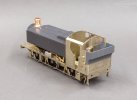
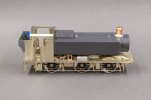
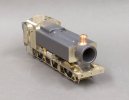
Rear bunker is just taped in place for photos as I need to ponder some aspects before fitting, cab is done apart from the roof which just needs forming and fitting.
Then it's back down below for sanding pipes, coupling rods, inside motion, buffers and pipework.
mickoo
Western Thunderer
Resin parts have their place and have been used many times on many kits over the years, decades even. As far as the material goes, it's pretty robust and if you know how to work it, easy to work with. That's not to say all resin components are of the same quality or easy of use, some resemble a chewed dog toy in my opinion.Hi Mick- I'd appreciate your thoughts about the pros and cons of kits that feature these large resin components. They surely simplify construction, which appeals to a novice builder like me, but is there a trade-off?
It also depends on how the resin part has been designed and produced, older ones tend not to have sacrificial edges you can trim back to get a neat joint, you end up finishing off large flat areas and that can be a right pain, especially once flat it's then too small.
The biggest issue I suppose is adhering the extra metal parts onto the resin, there are as many different types of adhesive as there are days in a year so it does depend on your chosen poison and to some extent the type of resin. I tend to avoid super glues as they dry rock hard and have no give and in my experience tend to fracture and drop off, probably due to the two different materials expanding and contracting at different rates.
The same also applies to 3D printed parts, these are like resin parts but a different material and the choices of those materials is vast, unlike moulded resin.
I prefer to use an adhesive that's more plastic/fluid, glues like UHU, Devcon and Araldite seem to behave much better; I have a flex test on my window cill for a 3D print, a simple spring and horn guide glued to a strip of metal. Every now and again I'll bend the strip to see if the joint will fail; so far it's been nearly a year and the print hasn't fractured or the bond failed. The super glue ones failed days later, sometimes without touching.
Once you've established your prefered adhesive then there really isn't much to worry about from a construction point of view; one thing that does need further attention is the surface preparation for paint. Whilst the resin looks smooth naked it'll be different once you add paint, it'll show up all sorts of issues and can look orange peeled and it's usually not the paint causing this. Some resins are also quite porous (relative) and can take several/many layers to build up to a smooth surface.
The best bet is to prime with a filler primer that will key to the plastic and not be attacked by the top coats. Halfords do good primers, their standard metal one is good and they do a plastic bumper ones as well. Other alternatives I've used or seen first hand are Mr Surfacer and Tamiya.
It's important to take your time and get both surfaces as close as you can (smoothness) or else once the top coat goes on you'll see a slight tonal change as the light refracts off the surface. Satin or weathered models then you'll have no problems but high gloss workshop fresh and you could have a devil of a time getting it to match the metal work around.
So, in closure, yes the resin parts do save a lot of time, but you still need to take care and be mindful how you integrate that item into the metal model, sometimes conjuring up ways to fix the different materials can be taxing so what you gain with one can be lost with the other.
Last edited:

Dave Holt
Western Thunderer
Mick. You mention closing any gaps with filler. What do you use?
A friend who is more into plastic aircraft kits tells me that aero modeller often use superglue as a surface filler as it is more controllable in application than, say, Squadron filler, and can be filed and sanded when cured.
Dave.
A friend who is more into plastic aircraft kits tells me that aero modeller often use superglue as a surface filler as it is more controllable in application than, say, Squadron filler, and can be filed and sanded when cured.
Dave.

spikey faz
Western Thunderer
Mick.
There are a few so called flexible superglues being marketed, some of which are aimed at the modelling world. I have never used them, so have no idea if they're any good, but I do remember watching a video a while back where a chap was comparing the flexi and non- flexi superglues. The flexi superglue certainly seemed to withstand his attempts to remove the glued on part.
Mike
There are a few so called flexible superglues being marketed, some of which are aimed at the modelling world. I have never used them, so have no idea if they're any good, but I do remember watching a video a while back where a chap was comparing the flexi and non- flexi superglues. The flexi superglue certainly seemed to withstand his attempts to remove the glued on part.
Mike
mickoo
Western Thunderer
Correct, I used to use one from Loctite (480), it had a rubber component and was black, very expensive (just checked and prices have come down almost 50% since I last used it) and short shelf life.Mick.
There are a few so called flexible superglues being marketed, some of which are aimed at the modelling world. I have never used them, so have no idea if they're any good, but I do remember watching a video a while back where a chap was comparing the flexi and non- flexi superglues. The flexi superglue certainly seemed to withstand his attempts to remove the glued on part.
Mike
It was very strong and had good grip, but it was quite viscous compared to some of the thinner ones that will seep into the smallest gaps.
I suppose my issue is that I drop onto one that works for me and then stop looking elsewhere for alternatives, I tend to use a super glue (Amazon...so called... industrial grade) for holding pinned items to a resin block and Araldite for flat mating surfaces.
If I've 3D printed a blocky object like a sand box or tool box then I will print with a cavity inside, then on the metal work I'll add a mechanical fixing like a loop of wire or pigtail so that the adhesive will grip that as well.
My situation is slightly different when doing commercial work, you can't have bits dropping off. If you're doing it for yourself it's less of an issue, you just stick it back on but commercially you have to make an excess of caution when securing items.
mickoo
Western Thunderer
Dave,Mick. You mention closing any gaps with filler. What do you use?
A friend who is more into plastic aircraft kits tells me that aero modeller often use superglue as a surface filler as it is more controllable in application than, say, Squadron filler, and can be filed and sanded when cured.
Dave.
I exclusively use Milliput Fine, it sticks like the proverbial and is easy to work with once set, the only downside is the time it takes to set. I also have Tamiya fine epoxy (it's a bit like Milliput but you can't thin it with water) and sometimes use Holts knifing putty for scratches.
Milliput doesn't shrink either which is a good trait and I use a wetened blade or implement to smooth it before it sets; I've also mixed it into a thick slurry and painted it into really small gaps, dome or chimney flanges are a good example.
As in my previous reply, I've found something that works well for me and stopped looking elsewhere; though I have to confess, there have been times when one of the UV activated superglues would have been a great benefit.
spikey faz
Western Thunderer
I'm definitely with you on adding some sort of mechanical fixing. Glue is all well and good, but a belt and braces approach has many benefits. I try for nuts and bolts where possible, but I appreciate that this is not always practical on say a resin body.
Mike
Mike
mickoo
Western Thunderer
That's enough for one week, getting close to the end and looking grubby now, from this point on there's little point deep cleaning.
The metal work seems to take on a tarnish that's hard to shift without aggressive mechanical cleaning; that's hard to do with all the details now added.
The resin boiler assembly is still loose fitted but permanent fixing isn't far away.
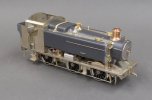

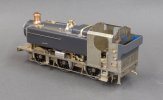

The metal work seems to take on a tarnish that's hard to shift without aggressive mechanical cleaning; that's hard to do with all the details now added.
The resin boiler assembly is still loose fitted but permanent fixing isn't far away.

mickoo
Western Thunderer
Cheers, door is white metal.Looking good. What material is the smokebox door?