Breaking Ground - Finescale - of a sort

Peter Insole

Western Thunderer
Thank you Mike, it is indeed supposed to be a non specific, narrow gauge, no particular scale or prototype, semi industrial, practically operational railway after all!

Having said all that, the veiw of the line when first seen on the approach from the gateway does highlight the peculiar kinks in what otherwise would look more appropriate as a dead straight run! However, we are where we are in readily acheivable and practical terms.

Perhaps a little history might help to explain the rationalle (if any exists?!):

It all started with the Horwich engine, with which I was initially quite content to run on the peculiarly gauged, 5 3/4 inch portable track. The railway itself started later, with relatively low expectations of a simple, out and back, after discussions with two of my sons, one of whom I had previously and willingly granted sole resposibility for taking on the design and maintenance of the garden. Ever since, it would seem appropriate to work with his ideas and only with his full approval at every stage.

As so often happens, once the seed had beeen sown, the project grew - and has now become a major cause in it's own right!

The primary purpose of the western extension was the result of discovering, quite early on, that whenever operation was desired, and with my declining health being a significant issue, having to carry the locomotive half way down the garden to the nearest railhead was going to become an increasing difficulty. Bringing the rails as close to the house as possible is still seen as the best way to reduce the problem.

Among other benefits of this decision will clearly be a longer run to ride on for pleasure, and also provide carriage of heavy items and bulky materials - especially gardening provisions etc., delivered to the driveway, and then transhipped directly - much more quickly and easily than lugging or struggling through narrow spaces with a wheelbarrow - something that has already been thoroughly proven, albeit partly with the slightly less satisfactory (on unneven ground) portable track!

Although a single track, dead end route with insufficient space for any form of run-round, and unbelievably tight curvature in places may be awkward for normal, loco hauled operations... it could also be perfect to satisfy another passion of mine...

A traditionally styled electric tramcar, with reversible seats, can be driven from either end!

Whilst I am utterly determined and still reasonably focussed, I just hope I can keep going for long enough to realise that particular dream!

Pete.
 

Mike W

Western Thunderer
Thank you Pete, understood. I did wonder if it was a railhead from which, on special occasions like village fetes, further portable track could be attached to run off down the road! As for the track formation having to divert around immoveable objects - just like the real thing.

Just brilliant

Mike
 

Peter Insole

Western Thunderer
Wouldn't that be a lot of fun Mike?!

We (family) have been chuckling only recently at the suggestion of installing open crossing signs with wig-wag lights as a tease for the other residents of the hill... which incidentally is both a private road and cul-de-sac - also with no turning facility!

By far and away, the majority of our neighbours are charming, delightful and friendly, or at the very least, quietly tolerant... but there are a few - as always to be found in any community - that sadly seem to be a bit short on humour!

Might perhaps be best not to put that notion to the test though?!

Pete.
 

James Spooner

Western Thunderer
This could so easily descend into silliness, which is something that I would be terribly disappointed if it didn't happen!

On a slightly more serious note, the ultimate goal of this extension has been the subject of just a little confliction from the beginning: Providing as much distance of rail to ride upon within boundary limits is an obvious attraction, and indeed, there is at least one significant operational benefit of being able to do so. There are however two distinct difficulties that I have with that. The first, and perhaps the minor issue of laying steel rails in concrete alongside the driveway is both a preference and at the same time an absolute necessity. As previously discussed on this thread; completing the final section of line with the same 16mm aluminium rails as the rest, in an area that must be shared by motor vehicles, and a heavier footfall, dictates a more durable, inset tramway type construction, but I also have a nagging fear that aluminium is rather attractive to scrap metal thieves - whilst the tops of thin strips of rusty steel might be marginally less so? Apart from that, the second point troubling me is perhaps more a case of perception? I cannot help feeling that if I were the Duke of Westminster... or at the very least an obviously successful, retired businessman, my interests and activities might be politely regarded as mere eccentricity - whereas I am clearly not - in which case similar behaviour might more likely be seen by the population at large as peculiar, and dare I imagine, even slightly dangerously so?! What people do in the privacy of their own homes and gardens may be tolerable to some extent, but I am afraid the moment those rails appear from under the gate - and into the full glare of the public gaze...(?) will I have crossed some form of Rubicon?

I have not particularly set out to seek attention in my local community, but it cannot possibly be avoided once the deed is done... and of that I am quite certain!

The Devil may care side of me is still winning though, and in reckless fashion, work on the "ladder" construction has commenced - regardless!

View attachment 240908View attachment 240909

In the end I decided to use M6 threaded rod for the "rungs". Not up to my usual belt and braces approach I know, but the size of the bar and size of the nuts fitted thereto determined that as a maximum to allow sufficient depth and flange clearance.

There was a bit of amusement to be had drilling consistent holes in the long, and quite unwieldy bars!

View attachment 240910

The "tie rods" are rather slender affairs, but I draw some comfort in the belief that they should only really be required to provide gauging - mainly during the pour and puddle phase of laying in the roadbed?!

View attachment 240911

That is the main, straight length ready... with the remaining half length needing an awkward curve bending in still to do.

A wagon sent down it for a test roared terribly, almost frightening my witnessing wife! I attempted to assure her that the noise was somewhat accentuated by the track being only loosely laid atop the path slabs!

It should, I trust be a little quieter when solidly set?

Hmm, who am I kidding? A seriously common complaint about trams was that they not only made an awful racket when in progress, but the fear that vibrations caused structural damage to nearby properties!

I do believe that was a factor that a certain Mr. Claude Lane discovered years ago, when the local authorities reacting to similar pressures, evicted him and his wonderfully glorious miniature tram from the seafront at St. Leonards?!

View attachment 240912
copyright image shown here for reference (inspirational!) purposes only.

In which case, if it is true; there's surely nowt as strange as folk... and I stand little chance!

Pete.
It all depends which year the photo was taken. I think St Leonard’s was 1951, but then for the next five or six years Mr Lane set up his miniature tramway in Rhyl, before settling in Eastbourne for the next ten years or so (where I used to ride on it, as my grandparents had retired there).

Nigel
 

Peter Insole

Western Thunderer
I don't really miss the act of driving, and certainly not the appalling cost these days of owning and running a motor car, but I do feel the loss of independence at times. One area of occasional frustration is obtaining materials for the railway, at least in the familiar manner that I am comfortable with anyway!

Choosing a particular mix of concrete for setting this last tramway section of the extension has been the cause of some concern for a while, and among other things, I have perhaps foolishly been thinking of every method and means to reduce construction expenses and complexity on the (not insignificant 30') length required. Ideally, having chosen to use threaded rod rather than any other form of sleeper/ties, I should have taken the opportunity to add a form of check rail - primarily for making the process of levelling the mix between the running rails a bit easier, but also for maintaining a more secure and clean edge for the flangeways. Unfortunately, a degree of laziness, a fear of the effect on a dwindling bank balance as well as freshly painful memories of the difficulty experienced forming the curves have all had a distinct impact on my decision making! I would rather simply drop thin strips of timber (any old reclaim will do) inside the rails during the laying process, something I have done in an inverse way before when making drip courses under cast in situ concrete windowsills. I know that in the longer term, wear and tear, plus the natural effect of weather will untidily damage those flangeways - but I'm prepared to live with that. I am also aware that conventional concrete "ballast" consists of mixed size and some broken stones in the mix. As such muck erodes, it can leave particularly nasty, and potentially injurious edges. Whilst the inclusion of sharp aggregate is doubtless for good reason, I would much prefer to use something like "Pea shingle". Scattering shingle on top of wet cement in "Pebbledash" fashion was briefly considered, but is perhaps not really an option - as over time the stones are liable to break free and leave a peculiar, patchy, miniature lunar landscape in their place?

Surprisingly, or perhaps not so in this age of internet shopping, I find that fine aggregates - indeed almost any come to that - are notably unavailable at the dwindling number of local builders' merchants in our district, so I find myself frustratingly reliant on the goodwill of others for transport assistance!

Laying a hard and carefully levelled foundation in a deep trench, with the rails set out on top once the mix has sufficiently hardened, thence followed by a covering, decorative layer is undoubtedly the best method, but as part of the formation alongside the the original paved area has a brick wall just below the surface on one side and well compacted hardcore, with a thin, levelling layer of sharp sand on the other. Digging that lot out would be a serious task, and otherwise, ending up with what would in effect be two thin cement layers (base and top coat) would be equally unacceptable.

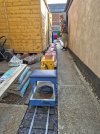
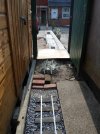
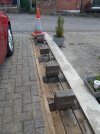
I decided in the end to leave everything alone below and support the rails at the required height with a series of cut bricks, blocks and pavers, while using bits of broken tile and slivers of slate for precision. The whole assembly is somewhat fragile, but a hard mix of plain mortar "dollops" packed all round the columns and bottom of the rails should be sufficient to hold it all in place until I have acquired the right materials for the main pour - shingle or grit and all.

hkSAM_2136.JPGhkSAM_2134.JPG
hkSAM_2138.JPG

Beyond the paviours, the whole area is made up of quite deep, well smashed and tamped hardcore, so I am trusting that maintaining a 4 to 5 inch depth of concrete, that to some extent is reinforced by the set in rails and ties themselves should be adequate?

The "road" will be contained by the reset original blocks, and a batch of new to complete the hardstanding, laid firmly up to the edge as well.

It will be interesting to see how it fares?!

Pete.
 

Peter Insole

Western Thunderer
Thank you guys for those absolutely wonderful suggestions!

Local folks still claim that our railway line was closed by Beeching, but to be fair, (if only for the sake of historical accuracy) it was unforgivably consigned to oblivion by an otherwise honourable Barbara Castle! Be that as it may, there was a hard fought campaign to prevent that happening in 1967, and ever since there have been many determined, but hopelessly over optimistic, and frankly misguided calls for reopening.

Our extension is, as it happens, heading in pretty much the right direction for a return to Cambridge... but there is the small matter of our ancient abode - and an estate of late sixties council housing getting in the way!

Pete.
 
Last edited:

Peter Insole

Western Thunderer
I am still recovering from a hectic afternoon on the railway this Monday last - well that is my excuse anyway! While the weather held fair that day, some (but sadly not all) of our family attended for a young princess's birthday party.

Mr O. had earlier defied the "No mow May" principle to make way, (and hay!) then Rich, Glenn & Co., kicked off the proceedings by providing the machinery, materials and manpower for a splendidly barbequed meal:

hkSAM_2147.JPG

The station became rather busy... but with so many delights on offer, unsurprisingly few people were particularly interested in what, if any train services might be operating!

hkSAM_2157.JPG

Later, when the screaming hoards where more or less satiated, the imminent arrival of a special train was announced...

hkSAM_2162.JPG
hkSAM_2161com20250602_191047.jpghkSAM_2169.JPG

Complete with cake and candles on the locomotive bonnet top!

That was an inspirational event that even "Grumpy Grandad", (the railway company director) wasn't expecting!

He finds himself realising that in the serious business of running a railway, goods services of such kind can be very good indeed... and that a precedent has almost certainly been set!

Pete.
 

Fitzroy

Western Thunderer
I
I don't really miss the act of driving, and certainly not the appalling cost these days of owning and running a motor car, but I do feel the loss of independence at times. One area of occasional frustration is obtaining materials for the railway, at least in the familiar manner that I am comfortable with anyway!

Choosing a particular mix of concrete for setting this last tramway section of the extension has been the cause of some concern for a while, and among other things, I have perhaps foolishly been thinking of every method and means to reduce construction expenses and complexity on the (not insignificant 30') length required. Ideally, having chosen to use threaded rod rather than any other form of sleeper/ties, I should have taken the opportunity to add a form of check rail - primarily for making the process of levelling the mix between the running rails a bit easier, but also for maintaining a more secure and clean edge for the flangeways. Unfortunately, a degree of laziness, a fear of the effect on a dwindling bank balance as well as freshly painful memories of the difficulty experienced forming the curves have all had a distinct impact on my decision making! I would rather simply drop thin strips of timber (any old reclaim will do) inside the rails during the laying process, something I have done in an inverse way before when making drip courses under cast in situ concrete windowsills. I know that in the longer term, wear and tear, plus the natural effect of weather will untidily damage those flangeways - but I'm prepared to live with that. I am also aware that conventional concrete "ballast" consists of mixed size and some broken stones in the mix. As such muck erodes, it can leave particularly nasty, and potentially injurious edges. Whilst the inclusion of sharp aggregate is doubtless for good reason, I would much prefer to use something like "Pea shingle". Scattering shingle on top of wet cement in "Pebbledash" fashion was briefly considered, but is perhaps not really an option - as over time the stones are liable to break free and leave a peculiar, patchy, miniature lunar landscape in their place?

Surprisingly, or perhaps not so in this age of internet shopping, I find that fine aggregates - indeed almost any come to that - are notably unavailable at the dwindling number of local builders' merchants in our district, so I find myself frustratingly reliant on the goodwill of others for transport assistance!

Laying a hard and carefully levelled foundation in a deep trench, with the rails set out on top once the mix has sufficiently hardened, thence followed by a covering, decorative layer is undoubtedly the best method, but as part of the formation alongside the the original paved area has a brick wall just below the surface on one side and well compacted hardcore, with a thin, levelling layer of sharp sand on the other. Digging that lot out would be a serious task, and otherwise, ending up with what would in effect be two thin cement layers (base and top coat) would be equally unacceptable.

I decided in the end to leave everything alone below and support the rails at the required height with a series of cut bricks, blocks and pavers, while using bits of broken tile and slivers of slate for precision. The whole assembly is somewhat fragile, but a hard mix of plain mortar "dollops" packed all round the columns and bottom of the rails should be sufficient to hold it all in place until I have acquired the right materials for the main pour - shingle or grit and all.

View attachment 241529View attachment 241530
View attachment 241531

Beyond the paviours, the whole area is made up of quite deep, well smashed and tamped hardcore, so I am trusting that maintaining a 4 to 5 inch depth of concrete, that to some extent is reinforced by the set in rails and ties themselves should be adequate?

The "road" will be contained by the reset original blocks, and a batch of new to complete the hardstanding, laid firmly up to the edge as well.

It will be interesting to see how it fares?!

Pete.
I just had the thought of a car decked out as a train ferry.....
 

class27

Active Member
They have all grown so much since the beginning of the Plastic toy train tale, |Got to enjoy while you can. Truly frightening how things like years don't last like they used to.........
 

Peter Insole

Western Thunderer
Crikey, yes indeed class27, it is almost terrifying!

I hope he doesn't mind me mentioning such things here, but Rich reminded me only the other day that young Mr. E., his eldest - and of course the original inspiration for this tale is now only one year younger than his dad was when he started "going out" with the girl who subsequently became a wife... and mother of the boy!

Gulp!

They didn't exactly rush into it either, so when Rich meekly enquired one evening: "Dad... erm... how would you feel about becoming a grandad?"

I loudly exclaimed; "About bloody time son!"

Pete.
 

Peter Insole

Western Thunderer
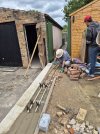
The past weekend turned out to be a rather frantic affair; as the main concrete pour on the tramway started a little sooner than I had expected.

A combined result of Mr. O's keenness to get on on with rebuilding the hardstanding and an element of minor miscommunication led to him announcing the two day hire of a cement mixer at the last minute, and unfortunately before I had the chance to gather all the materials required, or complete much of the essential preparations!

Coupled to that, after a such a long period of settled weather, we got caught in a deluge and thunderstorm on the Saturday afternoon, just as the second mix got underway, and steady rain was pretty much constant thereafter for the rest of the day. With so much to do, we could not afford to postpone, and consequently the pair of us became thoroughly drenched.

Needless to say, we didn't get any photographs of the proceedings that day!

Sunday however was glorious by comparison...

hkSAM_2200com20250608_140625.jpghkSAM_2200com20250608_160158.jpg

but equally bonkers nonetheless!

Due to both the tight schedule and, on my part, a hopeless underestimation of quantities, an appallingly high degree of bodgery was necessary.

At the end of play, we still have a short, but not insignificant gap to fill, but that will have to be done later by the more traditional method of mixing by hand!

hkSAM_2203.JPGhkSAM_2205.JPG

The first section came out really nicely, but more to do with working through the previous cloudbursts! The sheer power of the rain during the storm had a perfectly self-levelling effect, as well as prematurely exposing the carefully chosen aggregate! Sadly, the remaining works could not be made to remotely match, but as the mix is the same I have to hope that wear and tear over time will balance it all out a bit?

hkSAM_2202.JPG
hkSAM_2206.JPG

Incidentally, if anyone is wondering, the little white plastic wrapped parcels are my wife's idea for keeping expensive paviour bricks clean while being used to hold the timber flangeway strips in place after the clips were removed in advance of each pour. One piece of timber had an inevitable, but slightly more awkward twist at one end, so a weight had been left on top to allow the cement to harden enough to hold it down.

Prising the strips back out when it is all thoroughly cured will be a bit of fun yet to come... not to mention sorting out the rather poorly planned intersection beforehand?!

Pete.
 

ovener

Western Thunderer
Coming along very nicely there Pete. I am so enjoying your tales from the trackside, thank you.
We would need a rack and pinion effort in our garden as there is quite a slope.
No, I'm not going to even think about that.....:eek:
Richard
 

Peter Insole

Western Thunderer
Being concerned not to prematurely lift the timber flangeway strips out and potentially risk breaking the edges of the still fresh concrete, I had been hoping that a more prolonged sunny spell might assist by naturally drying out and shrinking the wood beforehand. Recent weather forecasts however threaten more heavy rain to come, so I decided to go ahead.

There was a small amount of loss in a few places, but I draw some comfort in the expectation that high traffic and general wear and tear will probably soften the whole lot in fairly short order anyway?!

hkSAM_2208.JPGhkSAM_2209.JPGhkSAM_2212.JPGhkSAM_2217.JPG

An initial test with a wagon revealed a few bothersome errors that crept in and caught me out... but with everything setting nice and hard it is too late to do anything about most of them now!

Whilst the rail lengths are reasonably flat and level throughout, the same cannot be said for the horizontal alignment, nor indeed my "puddling" efforts with the infill.

Admittedly from a visual standpoint, it is now rather obvious that I was perhaps a tad over cautious with the proportions of those flangeways, but then again, I am quite certain that they will rapidly become clagged with dust, muck and other debris, so having a deep and wide recess might make clearing them a slightly less fraught exercise in future?

A more tricky issue revealed by the test is that in places, mainly on the driveway side, the infill surface is too close to the rail head. The majority of our rolling stock tyre treads are broad, narrow gauge profile, and as they are free turning on fixed axles, have only marginal tapers. I forgot to make sufficient allowance for this, and consequently the rims catch on some high spots and raised stones projecting above the mix!

Damn and blast it!

There is no alternative, but I shall have lay meself down, slowly run a wheelset back and forth, then carefully mark each point of aggravating aggregate for grinding away.

If that were not bad enough, such foolery will not be performed in the privacy of an enclosed garden, but no; to my utter shame, in the full glare of the public gaze!

Serves me right!

Pete.
 
Last edited:
Top