Heljan class 45/0, conversion to S7

RichardG

Western Thunderer
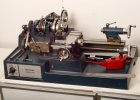
Please remind me what lathe you are using. Maybe post a picture of it as I'd be interested to see how big/small it is.

DSC_2800.jpeg
The base is about 490 mm long.

I don't have the specifications for this exact machine, but I suspect they are the same as for the newer ones, which I've copied from the manufacturer's website:

Centre height over bed - 44.45mm - 1.75"
Distance between centres - 203mm - 8.0"
Height - 225mm - 9"
Swing in Gap - 120mm - 4.7"
Swing over Crosslide - 47mm - 1.85"
Weight - 22Kg - 49 lbs

I've put a steel rule in the tray to give an idea of the overall size. The machine is standing on Ikea 'Billy' bookcases. It fits these nicely except there is no room to open the gear cover (it hinges backwards), so this has to to lifted off. And the machine looks nicer without it. The machine is designed to be portable, placed on a bench or table like a sewing machine, but I like the extra height of the bookcases.
 

RichardG

Western Thunderer
DSC_2658.jpeg

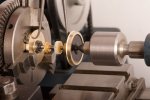
I remove about 0.22 mm in a few passes . . .

DSC_2663.jpeg

. . . and finish with a skim of around 0.03 mm to impart a reasonably smooth finish.

A mate has pointed out to me, I am using a lathe tool with a back rake. A back rake is good for steel but not so good for brass. I would have had an easier time of it with a flat-topped tool, and probably got a nicer finish too.

Looking though my collection, every tool I possess has a back rake, except for the S7 profile tool. And the profile tool gives a really fine finish.
 
Reassembly New

RichardG

Western Thunderer
Reassembly.

The wheels can now return to the model. The driving wheels are straightforward.

DSC_2732.jpeg
I think the easiest way to put the first wheel back onto an axle is to use the drill press. The hub on the front of the wheel is sitting inside the hole in the base of the drill press.

I press the chuck downwards in small movements, releasing the pressure and rotating the chuck a quarter-turn between each movement.

DSC_2733.jpeg
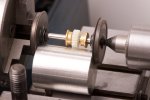
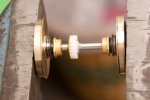
I use the lathe to install the second wheel. One approach is to set the B2B slightly too small against the callipers. Then use the gear puller to adjust each wheel until the B2B gauge fits snugly. This method gives more control over setting the axle symmetrically across the two wheels.

DSC_2649.jpeg
Alternatively, use the B2B gauge in the lathe. The axle may end up not perfectly symmetrical across the two wheels, but this will not show. In both of these operations, the pressure from the tailstock is setting up the wheel in or on the chuck.

DSC_2738.jpeg
The bench vice is also a viable way to adjust the B2Bs. The jaws are touching only the bosses of the wheels not the tyres.

When the wheelsets are set up they can be dropped back into the bogie, setting the long sides of the bearings horizontal. Then re-install the keeper plate.
 
Last edited:

RichardG

Western Thunderer
The carrying wheels sit in a sprung, loosely-pivoted pony truck. I found installing these wheelsets to be fiendishly difficult. I tried two methods, the second is better.

DSC_2749.jpeg
The broken sandpipe is the first casualty of the conversion so far. I only saw it when I looked at this photo, it must have been sitting here since I removed the bogie side frame.

DSC_2751.jpeg
To begin, fit the first wheel (to the right here) setting it slightly further onto the axle than it needs to be. Then use fingers to lightly locate the second wheel.

Method 1.

Open the jaws of the vice to accept the axle.

Use one hand to hold the entire model roughly horizontally, with model resting on the vice, the second wheel symmetrically above the jaws, the axle orthogonal to this wheel, and the model supported by your hand at its far end. The model is nearly half a metre long, so it is straightforward to keep the axle reasonably perpendicular to the top of the jaws.

Gently tap the axle downwards into the second wheel. Put the hammer aside and rotate the axle between taps, keeping the distant end of the model securely supported in your other hand.

Needless to say, I don’t have a photo of this underway.

Method 2.

This method needs two people.
DSC_2757.jpeg
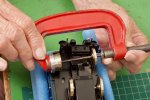
Hold the pressure pad on top of the second wheel, and then place a G cramp across the pad and the far end of the axle. Tighten the G cramp in small steps. One person holds the pressure pad concentrically on the wheel while the other person tightens the G cramp.

The pad will tend to wander, so slacken the clamp, rotate the axle and re-align the pad at each stage.

It is simplest to let the G cramp push the wheel too far. Then pull the wheels outwards to obtain the desired back to back.

DSC_2762.jpeg
The pressure pad is recessed so it pushes on the tyre not the hub. A 1/4 inch drive socket would be a suitable alternative if the G cramp is long enough to hold it.
DSC_2776.jpeg
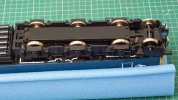
Install the two bogie side frame mouldings and reattach the buffer beam.

The side frames greatly reduce the side play on the wheels (the wheels are further apart than they were for 0 gauge) and so far I have not wanted to install spacing washers to reduce the play.

The second sandpipe was already sitting on a skew, so I broke it off before I lost it.
DSC_2771.jpeg
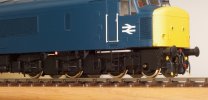
The second bogie, at the loco no.2 end.

DSC_2769.jpeg
The first bogie, at the loco no.1 end.

The model is easier to put onto the track than it was, because the wheels have less side play. It trundles up and down a length of flexi-track too.

I have doubts about the likely performance of the two pony trucks on complex pointwork, but I will wait and see before postulating corrective actions.

 
Last edited:

RichardG

Western Thunderer
In East Anglia the water pH ranges from 7.5 to 9.5 and therefore alkaline and if used this would start to neutralise the acid in the blackening solutions - the higher the dilution the weaker the blackening solution becomes until it has been neutralised making it ineffective. Ideally you would use distilled water or water from a dehumidifier as their pH values are closer to neutral pH 7.

Years ago I bought distilled water from the village pharmacy but today they had none in stock. So I have tried deionised water instead, which should also be ph 7, this mixed with the Philips "Professional Cold Blue".

DSC_2804.jpeg
Soaking the bare brass wheels in a mix of about 1 part cold blue to 2 parts deionised water creates a silver-grey patina a bit like steel. I have done two applications an hour apart, changing the rinse water in between.

This finish is much smoother and more even than the finish I obtained using the Pearson's "Antiquing Patination Fluid" mixed with Essex tap water.

I realise this finish won't last very long on the track, but the steel-like effect might be useful for other modelling where it can be varnished. Infuriatingly, I had to extract the carrying wheels to treat them to match . . .
 

Yorkshire Dave

Western Thunderer
I realise this finish won't last very long on the track, but the steel-like effect might be useful for other modelling where it can be varnished. Infuriatingly, I had to extract the carrying wheels to treat them to match . . .

Nowt to worry about, running it on the track will polish the correct areas as per prototype - the wheel treads and the flanges - so they will appear cleaner.
 

RichardG

Western Thunderer
This method needs two people.

DSC_2757.jpeg

Hold the pressure pad on top of the second wheel, and then place a G cramp across the pad and the far end of the axle. Tighten the G cramp in small steps. One person holds the pressure pad concentrically on the wheel while the other person tightens the G cramp.

The pad will tend to wander, so slacken the clamp, rotate the axle and re-align the pad at each stage.

It is simplest to let the G cramp push the wheel too far. Then pull the wheels outwards to obtain the desired back to back.

DSC_2810.jpeg
I have discovered, I can put the carrying wheels back single-handedly if I fix the pressure pad to the second wheel with some masking tape. Doing the task alone, it is fairly straightforward to place the B2B gauge into position and settle the second wheel against it.

These Heljan wheel bushes don't like being disturbed too often. After the first removal and refitting, the bushes want to stick to the axle and come adrift from the wheel. I have tried CA glue in the wheel hubs, left overnight to cure, and this didn't lock the bushes into the wheels.

So I hope all the wheels are back onto their axles for the last time.
 
Top