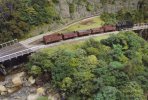
Rewanui (1940 NZR in 1:64)

Lawrence Boul

Active Member
Responding to a suggestion from SimonD that a model deserved its own thread...

Rewanui is a work in progress that features elsewhere from time to time. First and foremost it's a place where I get to try stuff. So this thread is likely to be occasional and eclectic, but will all be based around this South Island West Coast NZ coal branch in 1940.

An interesting prototype:
  • 3' 6" Narrow gauge
  • A Fell incline (centre rail used for braking only in this case)
  • No road access
  • Once a day there are two engines in the yard.
As a result there are frequent short trains of interesting vehicles, including a relatively intense passenger service. The morning miner's train is 7 cars. This was the last duty for vehicles before being written off, so they have character. But there is a lot known. Numerous images, drawings and file archives are accessible, even some film.

It's 100% scratchbuilt other than rail, motors and gears etc. But I'm a small manufacturer, so scratchbuilt also means that I'm building my own kits. Very little is completely finished, but it's progressing quite fast now.

The trackwork is simple as more or less just the station is modelled, with virtually no compression. Trains come up the incline from a fiddle yard. Empties are shunted over a back shunt bridge to the offscene bins (also the fiddle yard). In this way full/empty exchange is achieved invisibly. It's really a shunting plank. I've nowhere to put it, so the layout only actually runs at exhibitions. That's OK as my attention span is short and I have a lot of other things on the go.

Track is NMRA compliant, but wheels are a bit of an orphan profile that is not too far over scale. This is an accident of history that I've no intention of changing at this point. If I had time over, I would tighten the track standard, but I can live (just) with wide flangeways.

So to kick this off, one of the big issues was autocoupling. The layout is deliberately high and I wanted some action to be seen through the trees. That can only work with reliable autocoupling. NZR used 'Norwegian' choppers, so that was a hurdle. The video from a year or two ago shows how this turned out as well as showing the control system which is a custom application running as a webserver on top of DCC-Ex. The schematic shows how uncoupling works. In reality coupler centring is no problem as with hands free uncoupling the couplers stay centred (but they are magnetically centred, as I'm a belt and braces type).

Finally there is an image of some actual modelling.


uncoupler mechanism.JPG
 

Attachments

  • Wa217-on-backshunt.jpg
    Wa217-on-backshunt.jpg
    608.8 KB · Views: 52

simond

Western Thunderer
Lawrence,

what is the purpose of the smaller (6x6) magnet in the rotating/inverting uncoupler?

cheers
Simon
 

Lawrence Boul

Active Member
Lawrence,

what is the purpose of the smaller (6x6) magnet in the rotating/inverting uncoupler?

cheers
Simon
The geometry of the couplers is such that the hook needs to be pushed up (obviously), but it can (as with the prototype) go over centre, so the other magnet is to pull it down. It probably increases the overall magnetic field in a useful way as well.

In practice this is actually a little painful. Early thoughts were that with the hook up you could propel and place a vehicle, but that's not really needed or practically reliable (and you're stuck with a raised hook). There is no practical advantage to a raised hook, and it can be problematic if there is no available uncoupler to propel the vehicle over. My more recent coupler castings for personal use have departed a little from scale in that a) the uncoupled hook is prevented from dropping quite as low as the real thing can. This makes coupling up a little more reliable through improved geometry, and b) there's also a little lug that prevents the hook from going over centre. Performance was close to 100%, but without those mods it sometimes took a couple of goes, or you needed to couple with a bump to pop the hook down.
 

40057

Western Thunderer
Hi Lawrence

The landscaping, water and vegetation looks fantastic. I have never been to NZ, but your tree ferns look exactly like those in woodland gardens on the west coast in Britain. Am I correct in identifying some of your trees as Nothofagus? (Again, quite widely grown in the UK in gardens and parkland.)

Martin
 

Lawrence Boul

Active Member
Hi Lawrence

The landscaping, water and vegetation looks fantastic. I have never been to NZ, but your tree ferns look exactly like those in woodland gardens on the west coast in Britain. Am I correct in identifying some of your trees as Nothofagus? (Again, quite widely grown in the UK in gardens and parkland.)

Martin
Thanks Martin

When I was doing undergraduate botany they were. These days I think they've played with the taxonomy a bit.

The plant cover in the area is temperate rain forest. Plenty of ferns and moss with epiphytes growing on the tress. Mostly southern beech (Nothofagus) but podocarps as well (which are harder to model). The line was opened in 1910, and as you might expect the forest in and around the station was removed. So by 1940, vegetation would be 30 odd years of regrowth.
 

40057

Western Thunderer
Thanks Martin

When I was doing undergraduate botany they were. These days I think they've played with the taxonomy a bit.

The plant cover in the area is temperate rain forest. Plenty of ferns and moss with epiphytes growing on the tress. Mostly southern beech (Nothofagus) but podocarps as well (which are harder to model). The line was opened in 1910, and as you might expect the forest in and around the station was removed. So by 1940, vegetation would be 30 odd years of regrowth.
Hi Lawrence

My first degree was botany too (admittedly now a very long time ago). But I could immediately see your vegetation was beautifully modelled by someone who had closely observed the real thing.

Martin
 

Lawrence Boul

Active Member
This indifferent copy of a 1954 J Joyce image from atop the water vat sums up most features of the layout , which is, I suppose a branch line terminus.

Everything on this side of the Seven Mile Creek will be modelled. The private party tub trestle and bins in the background on the left will not.

This image is probably of an excursion. While busy, the station did not generally get quite this much passenger traffic.

Features:
  • The station master's house is out of frame on the left, but his garden can be seen.
  • The dark shed is, I believe, accommodation for some junior staffer and pretty grim it must have been.
  • The station building is obvious, and detached behind it the gentlemen's convenience and lamp room.
  • The bridge in the background is the only extant feature in this image. It is a railway bridge (but without track), and provided dray access to the mines which are much further up the valley. In reality it was primarily pedestrian access to the hoist that took miners to the mines above.
  • Locomotives are We class 4-6-4T. They started life as Sharp Stewart built class B 4-8-0 tender engines. Note the cut outs in the cowcatchers to clear the centre rail on the incline. In 1940 there were only 2 of these, 377 and 198. Both are shown here, though 198 had been renumbered 376 by this time.
  • The first vehicle in both trains is a 4 wheel Fell van. The guard was obliged to ride in this van on the incline and operate the gripper brake that acted on the centre rail. There were quite a few rules regarding the order of vehicles in the train. These related to safety and braking, but on the layout merely serve to add operational interest.
  • Many of the cars have elevated (clerestory) roofs. Open verandahs were a feature of NZ cars of the time.
  • The shed over the track in the background is for the 'ambulance'. In the event of injury to a miner, and if a train were unavailable, the ambulance (a modified wagon) could be worked by gravity to carry them to aid.
  • The single wagon on the ambulance road appears in quite a few images. It's a side tip muck wagon (I think) and was presumably used by the way and works dept to help clear the frequent slips on the line.
  • The bank on the right forms the backdrop for the layout.
There's an awful lot going on for what, area-wise, is a tiny branch station. We try to run the real timetable (although anachronistically we run a 1950s version as the workings are just slightly more interesting). Partly, this is all just part of the fun, but practically, running the actual timetable is an easy way to avoid shunting yourself to gridlock (though that still happens sometimes).

Rewanui 21-11-54 We376-377 JJoyce.jpg
 

Lawrence Boul

Active Member
Furious posting here is possible as I'm catching the forum up with modelling from the last few years. Actual progress is not nearly so quick.

As a WR ex-pat, I'm aware that NZR engines are an acquired taste. Bear with it as you'll grow to love them.

Engines on the line were restricted to those modified to deal with the centre rail. In 1940 that meant cutaway cowcatchers, modified brake linkages and an additional steam actuated gripper brake that acted on the centre rail.

This thread was prompted by Simond's reaction to this engine (Wa217), and somebody else asked how you set about designing a kit for such a thing.

I'm not going to attempt an exhaustive dissertation on either the engine build or kit design here, but some comments:

NZR modellers are fortunate as almost all the drawings ever done seem to still exist, there's a pretty good photo record and government and enthusiast archives have done a good job of preserving records. You still have to dig stuff up, but it is generally possible.

I've no formal engineering training and I'm entirely self taught. Fortunate though to be learning at the beginning of the information age so things like CAD are second nature, whereas draughting is not. This stuff is all pretty easy with 30-40 odd years of experience, but it was not always like that.

Even without much experience it is pretty easy to lay out parts and to get them etched. When it comes to building something though, there is a world of difference between soldering together 4 cab sides and simply folding up an assembly. The difference is design, and it is what separates a good kit from an average one. The other key aspect is realisation. The methods and tolerances used need to achieve an appropriate fit. Experience teaches you things, so much of what I now do was learned the hard way earlier. The principle is the same though. I design Mk1 and build it. Anything that I find tricky to do clearly needs to be reworked so that it is easier. Easier means more enjoyment and a far better chance of a clean accurate job.

Digital is an an enormous advance. It's accurate, and cut/paste/copy/mirror/undo save a huge amount of time. The etchings obviously come from CAD, but so do all of the castings. These come from 3D prints in a castable resin, supplied to a contractor who does the investment and casting. Removing the wax moulding step has a couple of advantages. Firstly shrinkage and distortion largely occurs in the waxing. Secondly parts that don't need moulding can be significantly more complex and detailed. They can also be thin walled which makes them easier to use. The Wa chimney, domes and cylinders have a wall thickness of 0.5-0.7mm.

So, yes, I'm proud of the finished Wa, but most of that is down to design rather than assembly.

Wa-217-primed-1.jpg

So with the etchings it's mostly about designing to make things fold, self jig etc. to simplify assembly. As can be seen in the image above cabs are designed so that glazing is inserted into a slot within the cab side. Perfect glazing in seconds. I've got similar tricks for a host of other areas that are problematic. Some of these I came up with myself (to have them pinched by others), others I've pinched in return.

Wa217-3-300124.jpg
The 3 Greymouth Was were all rather different. Three distinct motions for starters. Wa217 shown had the underslung crosshead on a single slidebar (slide valve), 289 had the cross head slung under twin slidebars (slide valve) and 137 had piston valve cylinders and a crosshead fitted between a pair of slidebars. Most of the motion differed accordingly. On top of that just about every detail part varied. Great for the Rewanui modeller, problematic for the kit designer.
Below is the cylinder/slidebar/motion bracket casting for 217. It needs minimal clean up, and as a single piece avoids the hassles and risks of assembling from individual parts. Casting quality of late has improved quite a bit even over that shown. The jewellery industry has embraced digital design and 3D, which has pushed casting to keep up.
Casting-2-sml-130223.jpg

electrical-parts1.jpg
This is a recent sprue of electrical parts. The small junction boxes (1.2mm dia) have short spigots rather than needing drilled holes. This allows 0.4mm tubing to be used for the conduit. This is WAY quicker and easier than trying to drill the fittings and use wire. The embossed text on the generator is almost legible.
 

Osgood

Western Thunderer
....... As can be seen in the image above cabs are designed so that glazing is inserted into a slot within the cab side. Perfect glazing in seconds.
....

From the photo it looks like you have double-skinned the cab front in order to create a hidden pocket for the glazing material?
 

Lawrence Boul

Active Member
From the photo it looks like you have double-skinned the cab front in order to create a hidden pocket for the glazing material?
Yes Tony. Typically the cab structure folds up out of full thickness metal. The join is somewhere convenient, NOT on a corner. That gives an easily achievable square foundation. The visible detail is a skin, half etched generally with detail. The inner structure has holes to allow soldering the skin on from behind. There are 2 minor downsides to this. 1. If you are heavy handed or use too much heat the hole locations are visible as slight distortions in the skin. Easily avoided by being quick and sparing (or you could use epoxy I imagine). The other problem is that the internal surfaces need filling if that bothers you. It's pretty hard to see one way or the other to be honest.
 
Last edited:

Lawrence Boul

Active Member
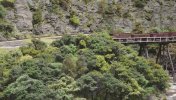
The prototype image of the yard posted a day or two ago was looking north from the water vat. The vat is just to the left of bridge 17 out of shot in this layout image looking south on the 'scenic' section. This section of the layout is relatively complete, although some bits were done in haste and should get a bit of finessing later.
Layout-progress-240925.jpg
In the background the line descends towards Greymouth with centre rail obvious. The steep rock face and tunnel exist on the prototype, but these features are much compressed and the runaway siding omitted entirely. In the foreground the backshunt curves over bridge 18 to the bins. In reality the trackage on the far side of bridge 18 was far more extensive that the 'station yard'. In my case it is all off scene.
Trees2.jpg
A similar view, but closer to a normal viewing angle. Others have suggested a theatrical approach to layout viewing with controlled sightlines and a useful tension in being unable to take in the whole thing at a glance. Trains intentionally get hidden by foreground elements as they move across the layout.
Layout-progress-2-100923.jpg
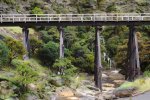
Bridge 18. The bridge is reasonably accurate, though the creek is less so. Information was a bit scarce when I built it. After closure a large landslide came down Davy Creek (through bridge 17) and removed much of the remaining infrastructure and the loss of a life. That event changed the nature and levels of the stream bed, and this view leans a bit towards the present landform.

layout-progress-180923.jpg
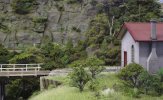
The exit to the fiddle yard disguised somewhat by the mine store. This building still exists but in very poor condition these days. The model is actually a mirror of the real thing repositioned as a scenic break. A trip to the local archives reading room turned up drawings. It's a modern scratchbuild of styrene, laser cut windows and 3D print details.
_HLB1292.jpg
The lamp on the corner of the building is a characteristic of government buildings of the period. The shade is shim brass pressed using a 2 part 3D printed former. The bulb is an LED, encapsulated in epoxy which produces a more appropriate diffused light. The conduit is 0.4mm brass tube and the enamelled electrical connections run through this. The 5" OG guttering is a 3D print that includes the barge boards, rafter ends and soffits. As such it is very robust and simple to integrate into the styrene structure.
 

Lawrence Boul

Active Member
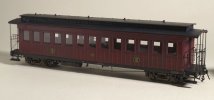
As noted earlier, Rewanui's passenger service was significant. With no road, mine workers had to travel both ways daily for all shifts and residents also needed a workable service. The miners and railways were strongly unionised and the Labour governments were not above dictating services that could not have been economic.

But the journeys were reasonably short. Greymouth was 8 miles distant and many miners lived in the intermediate settlements of Dunollie or Rununga. Most of the 6-7 cars of the morning miner's train remained parked in the Rewanui yard for much of the day before being used for the return trains in the afternoon. The cars needed to have centre rail clearance. Understandably then the cars used were dedicated to the service and were at the end of their usable life.

Prior to 1880, passenger cars were generally of 4or 6 wheel design from 'home'. In 1879 new 42' 6" bogie cars arrived from Gilbert Bush in New York. These cars formed and influenced the pattern and style of locally produced cars for the next few decades. By 1940 these first rate cars were gone, or almost so. A couple of them lingered at Rewanui, but were gone by the end of the year.

Being imports of considerable vintage the available information was not as extensive as it usually is, but there was plenty to make a model.

_HLB5947.jpg

The image above is for a different car, but shows the basic approach. In production the steps are castings and the floor/underframe is detailed. Parts are designed and orientated to suit the detail required and the constraints of the print bed. Queen posts, handrail knobs etc are also brass castings. Bogies have a compensated etched frame with printed cosmetic detailing. Unique to these cars as they had a 4' 6" wheelbase, whereas later developments had 4' 10".

GB-car1.jpg

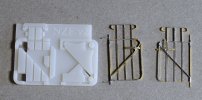
Actually building it is a pretty simple exercise from the prints. The window sashes are etched and individually glazed. They open upwards, and are all able to do so. Gates are also etched, and assembly with a printed jig is relatively straightforward. In the image below is a jig, my Mk1 gates (from my first etched project etched for me by Bill Bedford in 1996) and Mk2 which is a more recent thing in scale thicknesses. The Mk2 extension is a fold up and easier to achieve than the Mk1.

_HLB0992.jpg

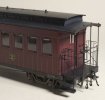
GB-car2.jpg
A cruel enlargement - remember this is a 16.5mm gauge model. Probably the car should be a bit more run down than this, but they are an elegant thing and I couldn't bring myself to abuse it too badly.
 
Last edited:

Lawrence Boul

Active Member
Rewanui was all about coal out, but there was some variety to loads.

Inbound traffic included explosives (latterly carried in surplus horse boxes), pit props, milled timber, vans of various sorts (and loads unknown). Even the odd coal load, as loco coal was sourced elsewhere. Of course there were also tarped loads in open wagons (highsiders). Perusing the period files at ArchivesNZ it also seems that outbound coal loads destined for gasworks were also sheeted - 50 wagons/week.

One current fascination is how to model these. I have numerous printable highsider models and the various etches and castings to produce decent models. The obvious approach is to model the sheets much like the real thing, and I looked at that. However, looking at the various attempts to achieve it wasn't that inspired. Some have achieved nice results, but I wasn't that confident I could replicate them.

The first thing I looked at was rope, and I found Ropes of Scale. This supplier provides real scale rope, primarily intended for ship rigging (and there are probably others). The finest available is 0.25mm (5/8" in 1/64). This is a bit overscale for the 1-1.25" (circumference) of the real thing but not too much. It's not just diameter though - it actually looks like rope.

I was fairly sure that a printed wagon including a sheet would work well, but the problem is how to convincingly do the digital model. Fortunately Blender has the requisite tools, though these are a bit of work to sort and apply.

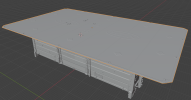
tarp model.png

The first step was to create a model of a tarp. Done as shown. This came from the NZR drawing and I've given the seams and lettering some relief to assist with later painting. The jury is out as to whether the lettering is a good idea, but the seams etc certainly are.

Blender allows you to define objects as 'cloth', identify objects that will interact with the cloth and simulation (animation), that allows gravity etc to do its thing:


That's relatively easy to do, the folds are convincing (and if you don't like them there are parameters to adjust until you do). the more complicated step is to simulate the lashing. One needs to:
  • Attach virtual ropes to the sheet, and connect these to the lashing points on the wagon
  • Let the tarp drape
  • Tighten the ropes on the wagon sides
  • Perform a more complicated tightening to the ends involving pulling the ropes longitudinally before tightening to achieve a ralistic wrap.
This isn't hard to do but is a bit time consuming to set up and adjust. The learning curve to work out how is a bit horrendous (or was for me)

The results are like this:


Once this is done, it needs to be made printable. In principle this is easy, but all of the folds make it a bit manual. But it is achievable once you find a comfortable method.

The rendered result is pretty good I think.
L1-render-header.jpg

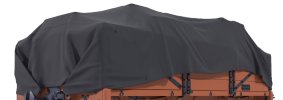
Test prints show great promise and this will all work really well. There's some minor tweaking to do and the usual faffing around to turn a sound idea into a practical outcome. The unpainted prints do not photograph well, so I can't show a real model at this point. Stay tuned...
 

Osgood

Western Thunderer
And presumably each time you go through the process, the sheet comes out looking slightly different - the way it hangs and folds?
Just as in real life.
 

Overseer

Western Thunderer
Rewanui was all about coal out, but there was some variety to loads.

Inbound traffic included explosives (latterly carried in surplus horse boxes), pit props, milled timber, vans of various sorts (and loads unknown). Even the odd coal load, as loco coal was sourced elsewhere. Of course there were also tarped loads in open wagons (highsiders). Perusing the period files at ArchivesNZ it also seems that outbound coal loads destined for gasworks were also sheeted - 50 wagons/week.

One current fascination is how to model these. I have numerous printable highsider models and the various etches and castings to produce decent models. The obvious approach is to model the sheets much like the real thing, and I looked at that. However, looking at the various attempts to achieve it wasn't that inspired. Some have achieved nice results, but I wasn't that confident I could replicate them.

The first thing I looked at was rope, and I found Ropes of Scale. This supplier provides real scale rope, primarily intended for ship rigging (and there are probably others). The finest available is 0.25mm (5/8" in 1/64). This is a bit overscale for the 1-1.25" (circumference) of the real thing but not too much. It's not just diameter though - it actually looks like rope.

I was fairly sure that a printed wagon including a sheet would work well, but the problem is how to convincingly do the digital model. Fortunately Blender has the requisite tools, though these are a bit of work to sort and apply.

View attachment 266124

The first step was to create a model of a tarp. Done as shown. This came from the NZR drawing and I've given the seams and lettering some relief to assist with later painting. The jury is out as to whether the lettering is a good idea, but the seams etc certainly are.

Blender allows you to define objects as 'cloth', identify objects that will interact with the cloth and simulation (animation), that allows gravity etc to do its thing:


That's relatively easy to do, the folds are convincing (and if you don't like them there are parameters to adjust until you do). the more complicated step is to simulate the lashing. One needs to:
  • Attach virtual ropes to the sheet, and connect these to the lashing points on the wagon
  • Let the tarp drape
  • Tighten the ropes on the wagon sides
  • Perform a more complicated tightening to the ends involving pulling the ropes longitudinally before tightening to achieve a ralistic wrap.
This isn't hard to do but is a bit time consuming to set up and adjust. The learning curve to work out how is a bit horrendous (or was for me)

The results are like this:


Once this is done, it needs to be made printable. In principle this is easy, but all of the folds make it a bit manual. But it is achievable once you find a comfortable method.

The rendered result is pretty good I think.
View attachment 266125

Test prints show great promise and this will all work really well. There's some minor tweaking to do and the usual faffing around to turn a sound idea into a practical outcome. The unpainted prints do not photograph well, so I can't show a real model at this point. Stay tuned...
That’s a good starting point. The shunters won’t be impressed you haven’t kept the hand grabs clear. It also looks more like a draped bed sheet rather than a thick canvas tarp which has been pulled tight using all the ropes to minimise flapping. I don’t think I have seen the NZR instructions for fitting tarps but there are photos showing how to roll the corner to avoid the hand grabs, but they could be later than your modelling period.
 

Lawrence Boul

Active Member
And presumably each time you go through the process, the sheet comes out looking slightly different - the way it hangs and folds?
Just as in real life.
I think so. Even if not, it's very easy to make a small change that would result in a different result. You'd want to make the load different in each case anyway I feel and that certainly will result in variety.

This is a bit painful to set up, I admit. However, once set as a template, subsequent runs for different loads or wagons are much quicker.
 

Lawrence Boul

Active Member
That’s a good starting point. The shunters won’t be impressed you haven’t kept the hand grabs clear. It also looks more like a draped bed sheet rather than a thick canvas tarp which has been pulled tight using all the ropes to minimise flapping. I don’t think I have seen the NZR instructions for fitting tarps but there are photos showing how to roll the corner to avoid the hand grabs, but they could be later than your modelling period.
A bit hard to keep vertical grabs clear. There was a change to loop grabs in 1928 after a fatal accident, but records show some wagons were written off in the 60s with straight grabs fitted. Old wooden highsiders in coal traffic would not have been a priority as they wouldn't generally be sheeted anyway. Images also show the handgrabs well wrapped. As I have the records for handgrab type I can model wagons that had straight and this would be largely true for Rewanui in 1940. There will be the odd loop grab for variety (more likely on newer La wagons). The method would cope with loop grabs, albeit a bit more of a fiddle.

The look is an interesting debate. Some images show sheets that behave as if they are thick (as you might expect) but others are closer to bedsheets in behaviour. But that is a criticism of my interpretation rather than the method. On the digital side you could adjust sheet behaviour to taste.

Likewise, there's the official way to fit sheets, but photos suggest that this wasn't normal practice which appears far more ad hoc. Again, if you want to pull every rope tight the method would allow that.

While I'm relatively happy with the look illustrated, this is a work in progress. This iteration will not get through to a real model, and is more proof of concept (thin edges, making sure ropes can be fitted etc). lashing-knots.jpg
 
Top